Showing posts with label health care reform. Show all posts

Thursday, February 10, 2011

How much are spending cuts really cutting, and what would we lose?

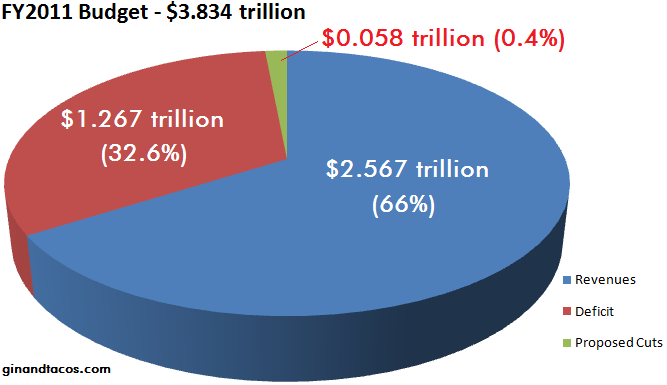
Sociological Images has a nice breakdown of Republicans' proposed spending cuts. Check out the post for a full discussion, but here is a helpful graphic:


So, in cutting 4/10s of 1 percent from the budget, what do we lose? Proposed cuts of over $1 billion to community health centers and the National Institutes of Health, among others. Oh, and let's not forget cutting the entire Title X family planning program. And $758 million from WIC.

I am so sick of the hypocrisy. This money spent on health and prevention prevents us from needing to spend much bigger sums elsewhere in the budget. Slash it, and watch other expenses rise. Or refuse to pay those expenses either, and let a huge swath of America suffer. Just to score political points ("we're not funding that horrible Planned Parenthood anymore!") for what amounts to a miniscule amount of total expenditures and doing very little towards deficit reduction.

Sunday, November 14, 2010

Balancing the budget and thinking about health care

One of our MPH courses, we had to do an exercise in which we figured out how to balance the federal budget. We had to do it through making spending cuts alone, and it was unbelievably difficult. It's a good reality check to have to weigh what you want to have happen with the realities of what else would have to be sacrificed to get it. It's a reality check I think more people should engage in when talking about social and health-related programs, taxes, and what cuts and increases really mean when we stop playing year-to-year budget shell games.

The New York Times has a new interactive feature up letting you try that exercise, both by cutting programs and increasing various taxes, with an article explaining how they made their calculations and what the long-term implications of the deficit fight will be:

It [the long-term deficit] comes from the projected growth of Medicare, Medicaid and, to a lesser extent, Social Security. It is the result of baby boomers’ having paid far less in taxes than they will draw in benefits. “The reason we find ourselves in this situation,” said Mr. Bowles, the former chief of staff for President Bill Clinton, “is that we’ve made promises we can’t keep.”

The deficit puzzle focuses on the year 2030 because it is far enough away that the boomers’ retirement will weigh heavily on the budget but near enough that reasonable budget estimates exist. By 2030, the needed deficit cut will equal about 5.5 percent of annual economic output.

By comparison, domestic discretionary spending — all of it, including Head Start, college financial aid, the F.B.I., medical research and airline safety — will add up to about 3 percent of economic output, according to Congressional Budget Office projections. Military spending will equal about 4 percent.

So the solution will have to revolve around tax increases and changes to health care and Social Security. And the country cannot wait until 2030 to implement most of the changes, notes Alan Auerbach, an economics professor at the University of California at Berkeley. If it did, the interest on the national debt could become crushingly large. Deficit cutting will probably be a regular part of politics for the next couple of decades.

It's very popular to talk about cuts in discretionary spending - "let's cut Head Start", "let's stop spending on military technology and spend it on education" but the truth is, entitlement spending is by far our biggest budget item and health care makes up a big chunk of that. Thinking about how to contain health care costs and yes, how to ration health care (not whether to ration health care, since it is already rationed, but how) are going to be a big part of this debate.

Sunday, September 5, 2010

US Dept. of Labor offers guidelines on break time for nursing mothers

The U.S. Department of Labor's Wage and Hour Division has a fact sheet out for employers and employees, explaining more about the break time for pumping mandated in the health care reform law. Here's an excerpt on the space requirements:

Employers are required to provide a reasonable amount of break time to express milk as frequently as needed by the nursing mother. The frequency of breaks needed to express milk as well as the duration of each break will likely vary.

A bathroom, even if private, is not a permissible location under the Act. The location provided must be functional as a space for expressing breast milk. If the space is not dedicated to the nursing mother's use, it must be available when needed in order to meet the statutory requirement. A space temporarily created or converted into a space for expressing milk or made available when needed by the nursing mother is sufficient provided that the space is shielded from view, and free from any intrusion from co-workers and the public.


Read the rest here.

Tuesday, March 23, 2010

Health care reform and looking down the road to the next reform

Am I excited about health care reform? Yes, although after all the back-and-forth and ups and downs, it ended by feeling a bit anticlimactic - stumbling across the finish line in a daze, just glad to have gotten here. Remember when Obama said he wanted it done by last August?

I am hugely frustrated, as many other people are, by ridiculous restrictions on abortion coverage. I'm also seriously disappointed by the lack of coverage for immigrants (and not just undocumented immigrants - there's a 5-year waiting period even for documented immigrants to get on Medicaid). And I just want to tell a little story.

The CenteringPregnancy group I'm co-facilitating right now is Spanish-speaking, so obviously most of the women are fairly recent immigrants from Latin America. The way Medicaid works, at least in this state, is that when you show up for your first prenatal visit you get two months of "presumptive eligibility". That means that Medicaid will let you get two months of care, and after that you have to prove that you're Medicaid eligible to continue to be covered. So the clinic tries to get as much done as possible before the two months is over. After that, you're paying out of pocket until you go into labor, at which time emergency Medicaid kicks in to cover the birth and a short period thereafter.

At last month's Centering visit, one of the participants got a call - during the visit - that her husband had been arrested and was about to be deported. At this month's visit, we found out that he was deported and that she was struggling to support her family. She was worried about having enough money for food for her other children. At the end of the group, she began to cry. And on top of this, she has to deal with the expenses for this pregnancy. She has an ultrasound scheduled but will have to decide whether to try to scrape together the money for it, or skip it altogether.

Worse, if she or any of the other women outside of their Medicaid eligibility need to be admitted to the hospital for some reason, like blood pressure monitoring, they'll end up with the bill from that too, and those bills are just insane. This is the reason we're getting health care reform, and yet we are making it impossible for a significant segment of the population to access.

Acting like undocumented immigrants are somehow leeches on taxpayer funds is a falsehood. Undocumented immigrants DO pay taxes. Many pay income taxes, and nearly all have payroll taxes taken out. And all of them pay sales taxes. They put a staggering amount of money into Social Security that they can currently never hope to see returned to them. Is all of this so terrible that they won't even be allowed to purchase insurance, again using their OWN money, on the insurance exchanges? God forbid they ever be able to receive Medicaid coverage for medical necessities.

And the thing that really gets me about all this is the fact that all of these pregnant, uninsured undocumented women? Their babies will be born American citizens. Medicaid will willingly, automatically cover those babies and any health problems they have (perhaps as a result of inadequate prenatal care?), for the rest of their lives. But we won't take care of their mothers, even during their pregnancies.

Obama says immigration reform is coming next; it can't come soon enough after this health care bill.

Tuesday, December 1, 2009

New protections for nursing mothers in Senate health bill

From the Wall Street Journal Health Blog:

Here’s a detail in the Senate health-care bill we hadn’t noticed until now: Employers would be required to give nursing mothers “a reasonable break time” to express breast milk during work.

Employers would also have to provide “a place, other than a bathroom, that is shielded from view and free from intrusion from co-workers and the public, which may be used by an employee to express breast milk,” the bill says.

Companies with fewer than 50 workers would be exempted from the requirements if the rules imposed “an undue hardship.” You can read the provision yourself on page 1239 of the Senate health-care bill. Similar legislation has been introduced in Congress for years, but has never become law.

More than 20 states already have laws in place to protect nursing mothers in the workplace, according to a Kaiser Health News story that highlights several provisions in the Senate bill that haven’t drawn much attention.


There's plenty to say about ignoring extended maternity leaves in favor of lukewarm pumping protection, but at least this would extend some extra protections to women working in states that don't currently protect their right to express milk. It also shows there's at least one prevention-minded initiative in the health care bill!

Thanks for the link go to Adriane, my classmate and policy guru extraodinaire!

P.S. I just realized this is my 200th post to Public Health Doula. Wow! Thank you for reading, commenting, and sharing.

Tuesday, November 10, 2009

The Stupak amendment.

[Note: I posted this yesterday, then heard an NPR piece that made me think I hadn't understood the Stupak amendment's restrictions. I was heading out the door, so I didn't have time to revise; I took the post down until I had time to research and make sure I was right. This is something I feel very passionate about and I wanted to make sure I was as accurate as possible. Slightly revised version below.]

I called, on Saturday, but what more could I do? Mostly I just tracked the news and crossed my fingers. The fact that this came out of nowhere (at least for me) and was over with in a day feels so utterly unfair.

In case you are not familiar with the Stupak amendment, it is part of the recently passed House version of the health care reform bill. The amendment restricts the ability of public and private insurance plans, offered in government health exchanges, to provide coverage for abortion.

Read that again: AND PRIVATE. This is where I was unclear yesterday, but it is clarified today by this extremely helpful post from legal experts at Planned Parenthood. I'm quoting it extensively because given what I heard on NPR yesterday, I think there is still some confusion out there about the realistic effects of the Stupak amendment on abortion coverage availability in the exchanges:

The Stupak-Pitts amendment prohibits any coverage of abortion in the public option and prohibits anyone receiving a federal subsidy from purchasing a health insurance plan that includes abortion. It also prohibits private health insurance plans from offering through the exchange a plan that includes abortion coverage to both subsidized and unsubsidized individuals.

Thus, if a plan wants to offer coverage in the exchange to both groups of individuals, it would have to offer two different plans: one with abortion coverage for women without subsidies and one without abortion coverage for women with subsidies. These private insurance plans would need to be identified as either providing or not providing coverage for abortion.

Health insurance plans are highly unlikely to operate in this manner, and it is not even clear that this is feasible under the administration of the exchange and affordability credits. As one alternative, the Stupak amendment purports to allow women to purchase a separate, single-service “abortion rider,” but abortion riders don’t exist. In the five states that only allow abortion coverage through a separate rider, there is no evidence that they are available.

Furthermore, women are unlikely to think ahead to choose a plan that includes abortion coverage, since they do not plan for unplanned pregnancy. In addition, it is not clear that health plans would even be allowed to offer two separate plans under other provisions of the act, such as the anti-discrimination and guaranteed-issue provisions. Those elements of the bill, which are very important to consumers, may make it impossible for plans to provide two separate plans, one that includes abortion and another that does not.

Realistically, the actual effect of the Stupak-Pitts amendment is to ban abortion coverage across the entire exchange, for women with both subsidized and unsubsidized coverage.


(emphasis mine)

Why the Stupak amendment? The argument is, as best I can tell, that those people who can't use all their own money to buy health insurance will be eligible for a government subsidy. This will probably be me at some point very soon (like after I graduate from school in May) so let's take me as an example. I could use the subsidy to buy a health insurance plan that covered abortion. Then I could use that money (along with my OWN!) to buy a private plan. Then, if I needed an abortion and that insurance plan covered it, the government would have somehow, indirectly, kinda sorta had a hand in making it possible for me to get a legal medical procedure.

Did I say legal medical procedure? I also meant abortion. They're the same thing, so sometimes I use them interchangeably.

We have had the Hyde amendment in place since 1977, exempting abortion from Medicaid. Poor women, expendable: check. Apparently health care reform is an opportunity to go even farther: to reach into PRIVATE health insurance, paid for with PRIVATE money, and effectively take abortion coverage out of that, too. This applies not just to individuals, but to businesses; companies that buy plans through the exchange? All their employees' families will lose any abortion coverage they had. All women, expendable: check.

The fact that this amendment comes from the party that has been ranting and railing about "government taking over health care" and using scare tactics like death panels and rationing of care...well, I guess irony has been dead to the Republican party for a long, long time, so we shouldn't be too surprised.

Besides women who need abortions, who else will this hurt? How about women who have miscarriages? Is maternity care next? Keep in mind, this comes from the same party that says health insurance shouldn't cover maternity care, because men don't need it.

This just...disgusts me. Last year I went to a talk by Dr. Nick Gorton and blogged about how he predicted this very outcome - that reproductive health care would be one of the issues to suffer when government stepped into health insurance. At the time, I mused about how we could protect abortion and other political hot button issues in health care reform - but reform seemed so theoretical. I guess I haven't been paying enough attention - but that's going to change. I agree, let's not just be satisfied with keeping Stupak out of the final bill - let's go after Hyde.

If you'd like to take further action now, this is a great place to start: While there's a wall of shame for Dems who voted for Stupak and against reform, there are some bright spots. Those are Democrats who voted AGAINST Stupak and FOR health care reform - despite being in highly vulnerable races next year. Click here to donate to those reps, reward their courage, help keep them in Congress, and send a message to the party: Do NOT allow the Stupak amendment into the final bill.