My next series of guest posts is from my friend and fellow doula, Chris. Chris and I became friends and doulas at the same time, on our AmeriCorps maternal and child health team. She has remained my friend and doula sister ever since - years later I still sometimes call her to process a tough birth. Chris is an awesome doula, a great friend, and a smart cookie! She's is expecting her first baby now (hooray!) and her posts for this blog are on her experiences with prenatal care, birth preparation, and (eventually) her birth story.
Before that series begins, I asked Chris if I could introduce her with a piece she wrote at the end of our AmeriCorps service. As part of the intro for the incoming MCH team, we each wrote up one birth story to help them get an idea for what our doula work was like.
Chris' story was really beautiful and I have found myself retelling it often recently as novice doulas have sought me out for advice about being a new doula. These newly trained doulas are expressing their worries about how they won't know how to help or what to do in the birthing room. I remember these concerns so clearly, along with the worry at births that I should always be doing and/or saying something because if I wasn't "doing something", I couldn't be doing anything, right? Yet like Chris, often the births where I felt most useless or helpless were ones where I was thanked effusively later by the mother and her support people.
The more births I attended, the more I realized the value of presence alone. I started to let my presence be enough: if something needed to be done, I did it; the rest of the time I could just be - be positive, be calm, be present. I tell new doulas this story to help them work through those concerns about knowing what to "do" and help them feel more confident that their presence is perhaps the single most important thing they bring to the birthing room. It is also a great story about the importance of doula support for all women and how we as doulas need to work hard to make sure we support programs that offer doula support to those who need it the most.
Some details have been changed to protect the client's privacy.
----
I was on my way out of the hospital after being a doula at a truly amazing birth when I got the call that a doula was being requested at a different hospital. Coming off such a beautiful delivery, I was still feeling great - energetic, excited, and in love with my job. By the time I drove across town to the other hospital, I was feeling the weight of the day and starting to drag.
The birth I had just come from was wonderful - very natural, lots of labor support from family, a wonderful midwife. When I walked into the second delivery room, the atmosphere could not have been more different. Instead of a sunset coming in through the window, there was fluorescent light. Instead of soft music, there was beeping from the IV pump and thumping from the fetal monitor. The mother, Elena, was all alone, hooked up to Pitocin, receiving IV pain meds, and thrashing and moaning through contractions. Just as I walked into the room, the nurse gave her another dose of medicine.
The thing about meeting a woman for the first time when she is in active labor is that she doesn't talk much. In fact, women in active labor without an epidural usually don't want to talk at all - they've got something much more important to focus on. I took Elena's hand, and helped her breathe through the next contraction. I didn't feel like I was helping - I figured that the reason she was calmer was the pain meds. She slept in between contractions and moaned when she was in pain, and for hours I sat next to her, holding her hand and rhythmically stroking her belly through contractions. She hardly spoke to me; the extent of our interaction included waking her up to say (in Spanish) "Elena? The nurse wants to know if you want more medicine." The nurse told me that Elena's husband was in jail, and that this was her first baby. I had no further information about the situation.
Elena progressed steadily, and sometime after midnight she was ready to push. She pushed out a healthy baby girl she named Stefania Espiritu. As they took the baby away to be examined and cleaned, Elena burst into tears. They seemed to be more than just tears of joy over the birth of a baby, and I asked her what was going on. "It's my husband," she said, "I just wish he could have been here. He's in jail. He got caught driving without a license and they were going to deport him back to Ecuador today." Her husband was an undocumented immigrant who happened to get caught doing something many other people do. But now he was separated from his family and had no way of even knowing about his new baby girl.
As I spent more time talking to Elena, I realized what a big moment this was for her and how important it was that I had been there. She had previously thought that she couldn't have children, though she had tried and tried. When she finally conceived, she and her husband were overjoyed. She kept repeating, "I didn't think I could ever have a child, and here she is." Her mother worked the overnight shift and couldn't be with her at the hospital, and she had no other person to support her. She looked to me and said "Thank you so much for being here! You helped me so much - with the breathing, and with the pain - I couldn't do it before you got here."
For hours I had felt pretty useless - the whole time she was in labor I thought I wasn't helping at all. To hear her thank me and to find out that I was such important support for her was incredible. I was so glad I could be there so she could share that moment with someone, so she could show off her baby, so she could tell someone her story. The staff at the hospital, while competent and sympathetic, couldn't be there for her in the way I was as a doula. I may not have done much, but my presence made a difference.
I spent several hours with her postpartum, just letting her talk. She had so much to share! By the end of it we had established a strong connection and I realized what a valuable service I had provided. Being a doula isn't just about breathing through contractions or changing positions or massaging through back pain--it's about being there, believing in a woman, and listening to her. A midwife once told me that doulas always help, every time. The more births I go to, the more I believe what she says.
I will never forget Elena or her story, and I am sure Stefania Espiritu will grow up to be as strong and beautiful as her mother.
Showing posts with label doula. Show all posts
Showing posts with label doula. Show all posts
Thursday, March 22, 2012


Monday, January 30, 2012
How college prepared me for being a doula
Sometimes - often as I'm heading to or from a birth - I'll think about the skills I draw on as a doula, and how I wasn't expecting college to have prepared me so well in certain ways for the life of a doula. I think it often enough that I decided I should do a post about it. So from least to most important, here's how what I learned in college applies to doula work:
4) Epidemiology and other courses that taught me how to read and interpret scientific literature
My master's in public health certainly built on and added to these skills, but I got a very solid foundation in college. Nearly all of my courses emphasized critically reading and analyzing primary literature. I have really enjoyed sharing the benefits of this with my doula clients - helping them understand the evidence for and against various interventions in birth or other concerns they may have.
3) Medical anthropology
Without question one of the most generally life-changing courses I've ever taken, and very applicable to doula work. So much of what we do as doulas involves negotiating the boundaries between very different cultures of birth, and understanding (and sometimes critiquing) those cultures AND our own. The most important thing I learned in my med anthro class was that "Culture is to people as water is to fish...you can't see your own culture because you're in it". It's difficult to mentally step back and try to see your own culture, but it's as important for a doula to understand her own personal mindset and cultural values as it is for her to learn more about those of her clients, the hospital staff, etc.
2) Spanish
I have a whole separate post on Spanish coming, but to summarize I will say that when I was an AmeriCorps doula this was vital. In fact, the Spanish skills of the doulas on my team got us called into a lot more births than we might have been otherwise. The nurses were NOT supposed to call us as interpreters, but they knew that having us around helped make the Spanish-speaking only patients feel more comfortable...and it did make the nurses' jobs easier. And there is a cultural preference on the part of many Hispanic women for unmedicated birth - all the harder to accomplish through language barriers - so very often a doula was especially appropriate. I haven't been to a Spanish-speaking birth in a while, but I'm pretty sure it would all come flooding back to me: "La cervix es la boca de matriz. Tiene que abrir de zero a 10 centimetros..."
And the number one thing I learned in college...
1) All-nighters
No lie. (All you doulas know I'm not lying.) I remember the first time I tried to pull an all-nighter in college I physically could not do it. I had to quit around 3-4 am and go to bed. A few more practice nights and I was able to push that out to 5 am...then to 7 am...and then I could enable my natural procrastination with nonstop marathons to finish those final papers the night before the deadline. I learned to accept the physical effects of sleep deprivation (for me, nausea) and find remedies (protein!) And I learned to carefully assess the correct way to manage getting back on schedule (short nap in the afternoon? or just stay up and then go to bed early?) I also learned to do this all without the use of caffeine (I know, I know - I was the only freakish college student not chugging coffee.)
All of this proved invaluable when I started attending labors that could last for 24+ hours and/or begin just as I was about to go to bed. And when I became a doula I discovered that giving counterpressure at 4:30 am is a actually easier than constructing supporting arguments for a thesis. And that while turning in those 20-25 pages is certainly a satisfying feeling, it doesn't really compare to the adrenaline rush of attending a birth. So while I still use my skills from those days, doula all-nighters compare very favorably to college all-nighters!
I guess the moral of all this is that if you're in college and an aspiring doula, take epi, med anthro, Spanish, and don't write any of your papers for those classes until the last minute! (Note: staying up all night partying is not equivalent preparation, but feel free to do some of that too.)
4) Epidemiology and other courses that taught me how to read and interpret scientific literature
My master's in public health certainly built on and added to these skills, but I got a very solid foundation in college. Nearly all of my courses emphasized critically reading and analyzing primary literature. I have really enjoyed sharing the benefits of this with my doula clients - helping them understand the evidence for and against various interventions in birth or other concerns they may have.
3) Medical anthropology
Without question one of the most generally life-changing courses I've ever taken, and very applicable to doula work. So much of what we do as doulas involves negotiating the boundaries between very different cultures of birth, and understanding (and sometimes critiquing) those cultures AND our own. The most important thing I learned in my med anthro class was that "Culture is to people as water is to fish...you can't see your own culture because you're in it". It's difficult to mentally step back and try to see your own culture, but it's as important for a doula to understand her own personal mindset and cultural values as it is for her to learn more about those of her clients, the hospital staff, etc.
2) Spanish
I have a whole separate post on Spanish coming, but to summarize I will say that when I was an AmeriCorps doula this was vital. In fact, the Spanish skills of the doulas on my team got us called into a lot more births than we might have been otherwise. The nurses were NOT supposed to call us as interpreters, but they knew that having us around helped make the Spanish-speaking only patients feel more comfortable...and it did make the nurses' jobs easier. And there is a cultural preference on the part of many Hispanic women for unmedicated birth - all the harder to accomplish through language barriers - so very often a doula was especially appropriate. I haven't been to a Spanish-speaking birth in a while, but I'm pretty sure it would all come flooding back to me: "La cervix es la boca de matriz. Tiene que abrir de zero a 10 centimetros..."
And the number one thing I learned in college...
1) All-nighters
No lie. (All you doulas know I'm not lying.) I remember the first time I tried to pull an all-nighter in college I physically could not do it. I had to quit around 3-4 am and go to bed. A few more practice nights and I was able to push that out to 5 am...then to 7 am...and then I could enable my natural procrastination with nonstop marathons to finish those final papers the night before the deadline. I learned to accept the physical effects of sleep deprivation (for me, nausea) and find remedies (protein!) And I learned to carefully assess the correct way to manage getting back on schedule (short nap in the afternoon? or just stay up and then go to bed early?) I also learned to do this all without the use of caffeine (I know, I know - I was the only freakish college student not chugging coffee.)
All of this proved invaluable when I started attending labors that could last for 24+ hours and/or begin just as I was about to go to bed. And when I became a doula I discovered that giving counterpressure at 4:30 am is a actually easier than constructing supporting arguments for a thesis. And that while turning in those 20-25 pages is certainly a satisfying feeling, it doesn't really compare to the adrenaline rush of attending a birth. So while I still use my skills from those days, doula all-nighters compare very favorably to college all-nighters!
I guess the moral of all this is that if you're in college and an aspiring doula, take epi, med anthro, Spanish, and don't write any of your papers for those classes until the last minute! (Note: staying up all night partying is not equivalent preparation, but feel free to do some of that too.)
Thursday, January 5, 2012
"Doula" in the New York Times crossword puzzle!
My family has always been big crossword puzzle fans - the New York Times crossword in particular. My grandmother, at eighty-seven, still completes the Sunday crossword every week. We're also, of course, Will Shortz (the crossword editor) fans in general; now that I'm working nights, I'm bummed that I miss out on listening to Weekend Edition on Sundays for his puzzles.
So imagine how excited I was to hear that "doula" was in this week's Monday puzzle: "58A: One providing nonmedical support for a woman in labor". Funny to read through the comments on a crossword blog about it - real mix of people who were very familiar with the term, and those who had never heard it before. But now they have!!
So imagine how excited I was to hear that "doula" was in this week's Monday puzzle: "58A: One providing nonmedical support for a woman in labor". Funny to read through the comments on a crossword blog about it - real mix of people who were very familiar with the term, and those who had never heard it before. But now they have!!
Wednesday, December 21, 2011
What's the opposite of NaBloPoMo?
I thought several times during November how it was ironic that I was reading through the fruits of other people's daily posting regime while almost totally neglecting my own posts. It got me to think about why I've fallen off in the posting, a trend which has continued well into December.
I do WANT to post! I like writing and being part of a great community and talking about this stuff. I don't want this blog to go dormant long-term. But I've also never been a super-disciplined blogger in the sense that I set goals for viewership or try to earn something from this (ha!) or even necessarily have a specific goal for the things I'm writing. When I first started blogging, my main goals were to 1) get all the birth-y stuff off my private blog and into the world where they could stop annoying the friends who didn't want to read it (but allow the friends who did to follow me and get to learn more about my experiences with the birth-y world) and 2) to have a dedicated place to think about maternal and child health/public health/doula stuff as I started grad school for my MPH.
Now I'm in a different place and sometimes it gives me a mini-crisis of conscience about this blog (not to mention my career path). I am no longer in school or even necessarily in public health at the moment. I work full-time as a lactation consultant where my job is very clinically focused. I am involved with research projects on the side and am trying to shoehorn more of that into my job, but it's not actually in the job description. In the meantime, with a full-time job I have definitely cut back the doula side of my life.
When I come up with ideas for posts, they tend to be sparked by the stuff I'm working on at the moment, so right now that is breastfeeding, breastfeeding, breastfeeding. Which is certainly a topic I've always covered on this blog (and was a passion of mine before I became a doula) but I look at the title of my blog and think "Hmm, it says Public Health Doula, not Clinical Lactation Consultant". It might sounds a little silly to try to stick to a title I chose on the spur of the moment over three (!) years ago, but I want to maintain a diversity of blog posts not just because it's what I originally intended to do with this blog, but what I originally intended to do with my life. I LOVE being a lactation consultant and doing clinical work, and right now as a newbie I am learning a huge amount about hands-on support, but I do want to end up in a public health-oriented direction and want to keep my hand in that (thus all the research projects on the side.)
Finally, it's complicated (as many doula and other health care professionals know) to maintain confidentiality (both for HIPAA and for my own ethical considerations); I composite and change details and all that good stuff, but that's a lot harder than just being able to tell the story of the class discussion I had yesterday.
All that is to say, the things that I used to do that sparked more diverse blog posts are less a part of my life now; and the things I DO do, I tend to second-guess posting about.
However, I think the hiatus has given me a little more fuel for the writing fire. I've seen some neat public health breastfeeding- and birth-related stuff recently and gotten very interested in writing about some issues from a public health perspective (co-sleeping, anyone?) There's also definitely a big post o' links coming from my starred items in Google Reader. (Still waiting for a Reader replacement...)
I am also piloting a shared-call arrangement with two other doulas to be able to keep attending births while working and am super, super excited to be able to consistently take doula clients (even if it's not many) for the foreseeable future. Hopefully that will get my doula thoughts going too!
So, that's my life-via-blogging update. I know the holidays aren't going to exactly focus my thoughts on new posts (more like focus on cookies...mmm, cookies), but I'm thinking there will be more to come in the new year.
I do WANT to post! I like writing and being part of a great community and talking about this stuff. I don't want this blog to go dormant long-term. But I've also never been a super-disciplined blogger in the sense that I set goals for viewership or try to earn something from this (ha!) or even necessarily have a specific goal for the things I'm writing. When I first started blogging, my main goals were to 1) get all the birth-y stuff off my private blog and into the world where they could stop annoying the friends who didn't want to read it (but allow the friends who did to follow me and get to learn more about my experiences with the birth-y world) and 2) to have a dedicated place to think about maternal and child health/public health/doula stuff as I started grad school for my MPH.
Now I'm in a different place and sometimes it gives me a mini-crisis of conscience about this blog (not to mention my career path). I am no longer in school or even necessarily in public health at the moment. I work full-time as a lactation consultant where my job is very clinically focused. I am involved with research projects on the side and am trying to shoehorn more of that into my job, but it's not actually in the job description. In the meantime, with a full-time job I have definitely cut back the doula side of my life.
When I come up with ideas for posts, they tend to be sparked by the stuff I'm working on at the moment, so right now that is breastfeeding, breastfeeding, breastfeeding. Which is certainly a topic I've always covered on this blog (and was a passion of mine before I became a doula) but I look at the title of my blog and think "Hmm, it says Public Health Doula, not Clinical Lactation Consultant". It might sounds a little silly to try to stick to a title I chose on the spur of the moment over three (!) years ago, but I want to maintain a diversity of blog posts not just because it's what I originally intended to do with this blog, but what I originally intended to do with my life. I LOVE being a lactation consultant and doing clinical work, and right now as a newbie I am learning a huge amount about hands-on support, but I do want to end up in a public health-oriented direction and want to keep my hand in that (thus all the research projects on the side.)
Finally, it's complicated (as many doula and other health care professionals know) to maintain confidentiality (both for HIPAA and for my own ethical considerations); I composite and change details and all that good stuff, but that's a lot harder than just being able to tell the story of the class discussion I had yesterday.
All that is to say, the things that I used to do that sparked more diverse blog posts are less a part of my life now; and the things I DO do, I tend to second-guess posting about.
However, I think the hiatus has given me a little more fuel for the writing fire. I've seen some neat public health breastfeeding- and birth-related stuff recently and gotten very interested in writing about some issues from a public health perspective (co-sleeping, anyone?) There's also definitely a big post o' links coming from my starred items in Google Reader. (Still waiting for a Reader replacement...)
I am also piloting a shared-call arrangement with two other doulas to be able to keep attending births while working and am super, super excited to be able to consistently take doula clients (even if it's not many) for the foreseeable future. Hopefully that will get my doula thoughts going too!
So, that's my life-via-blogging update. I know the holidays aren't going to exactly focus my thoughts on new posts (more like focus on cookies...mmm, cookies), but I'm thinking there will be more to come in the new year.
Monday, November 14, 2011
Nope, I won't bring you to a birth
Doulas and midwives probably get this a lot, and I get my share: "I am so fascinated by birth. I'm interested in becoming a midwife [or doula], but I'm not sure yet whether or not it's right for me. Can you help me find a way to attend a birth?" Sometimes people are asking specifically, "Can I come to a birth with you?"
My answer is always the same, "If you'd like to go to a birth, you should definitely do a doula training!" Doula training is a relatively low-cost and low-time investment, gives you a taste of learning about pregnancy/birth, and offers valuable knowledge about labor support if you plan to go into midwifery. Where I live, there is a local volunteer doula program that makes it easy for novice doulas to find their first clients. I tell people who ask that I am happy to be their "mentor" doula in the program (since the first birth they attend as a volunteer is always with a doula who has experience with the program), or to ask one of my doula clients if a doula trainee can come along to the birth.
I am surprised by how frequently people say "Oh yeah doula training, I thought about that, but..." The "but" usually has to do with lack of time or trouble scheduling or wanting to go to a birth sooner than the few months it will take to do the training and get set up with the volunteer program. They just don't have time, because they want to decide about midwifery real soon and go to a birth real quick.
I hear this enough and it starts to wear on me a little bit. I try to impress on the people who want to go to a birth, but skip the doula training, to think logically about the situation. There are a lot of people who want to be at a birth. Think about a hospital birth (since most births are hospital births). There's the mother's own family/friends/support people; there's the medical staff who need to be there (OB/midwife, nurse(s)); then there are other people who need to observe including medical and nursing students. For a midwife or doula to try to bring someone who's just curious to see a birth is usually not practical (and will probably exceed the hospital's visitor limits, which are often capped ridiculously low.)
Furthermore - and this is what I try to put gently to the people who ask me - to ask to attend a birth just because YOU want to see one, particularly just to ask to attend a birth of someone who is a stranger, is also unrealistic in terms of respecting the birthing woman's space. There are a few birthing women who have a welcoming "all-in" philosophy of birth - they don't mind having their whole extended family, neighbors, and FedEx guy watch them vocalize and pull off their clothes and push out a baby. Fantastic! It's their birth and they should have whoever they want there.
But most women want and DESERVE to hold a smaller space for their birth. They ask selected people to be there for a reason - because that person will have a lifelong connection with the baby, or because they rely on that personal for emotional security, or because that person offers them a great back massage and hip squeeze. Like I said, for a few women your curiosity in midwifery is reason enough to invite you to be present. I think that's totally fine. But for most, they're going to need something more.
I think the questioners do understand this on some level. That is why they don't generally call up pregnant women they happen to know and ask "Can I come to your birth?" They ask me to ask for them. And this is my bottom line: I won't ask. There's something that question that rankles in a way I had to separate out: beyond just trying to elbow into a private experience, it's specifically imposing on me as a doula. The questioner is asking me to use my experience as a doula and the trust I've built with a family for their own purposes, but is not going to invest their own time and energy to make that possible. To do a doula training gives you something to offer the birthing woman and a reason to be present; and it also gives me something important: honestly, I want to see, before I put myself out there, that you are serious about this interest in midwifery/doula-ing. Midwifery school and midwifery as a career are a huge commitment. It's not so much to ask to put in a couple months of prep as a doula to see if that's what you really want. If you won't, then I question whether this is just a passing idea.
Sticking to this policy, I've seen it pay off. The people who were serious and have continued to pursue midwifery, or doula-ing, became doulas without hesitation; the people who hemmed and hawed have discarded or put off the idea of birth work as a career.
Reading back over this post, I realize it sounds pretty negative to the idea of "just anyone" showing up for a birth. I want to re-emphasize that I am not opposed to a woman inviting whoever she wants to her birth - including someone she doesn't know very well, who has a passing interest in midwifery. And if someone out there has had the experience of asking and being happily invited to a birth in that scenario, more power to you - you're pretty lucky! But think hard before imagining that just getting to see a birth will help you decide about midwifery. After all, you can watch a million births on YouTube (I know, it's not the same, but still.) It's possible that what will really help you decide whether you want to be a midwife is not the 12 or 18 hours you watch one woman labor and birth; it is the experience and preparation that get you to that point.
My answer is always the same, "If you'd like to go to a birth, you should definitely do a doula training!" Doula training is a relatively low-cost and low-time investment, gives you a taste of learning about pregnancy/birth, and offers valuable knowledge about labor support if you plan to go into midwifery. Where I live, there is a local volunteer doula program that makes it easy for novice doulas to find their first clients. I tell people who ask that I am happy to be their "mentor" doula in the program (since the first birth they attend as a volunteer is always with a doula who has experience with the program), or to ask one of my doula clients if a doula trainee can come along to the birth.
I am surprised by how frequently people say "Oh yeah doula training, I thought about that, but..." The "but" usually has to do with lack of time or trouble scheduling or wanting to go to a birth sooner than the few months it will take to do the training and get set up with the volunteer program. They just don't have time, because they want to decide about midwifery real soon and go to a birth real quick.
I hear this enough and it starts to wear on me a little bit. I try to impress on the people who want to go to a birth, but skip the doula training, to think logically about the situation. There are a lot of people who want to be at a birth. Think about a hospital birth (since most births are hospital births). There's the mother's own family/friends/support people; there's the medical staff who need to be there (OB/midwife, nurse(s)); then there are other people who need to observe including medical and nursing students. For a midwife or doula to try to bring someone who's just curious to see a birth is usually not practical (and will probably exceed the hospital's visitor limits, which are often capped ridiculously low.)
Furthermore - and this is what I try to put gently to the people who ask me - to ask to attend a birth just because YOU want to see one, particularly just to ask to attend a birth of someone who is a stranger, is also unrealistic in terms of respecting the birthing woman's space. There are a few birthing women who have a welcoming "all-in" philosophy of birth - they don't mind having their whole extended family, neighbors, and FedEx guy watch them vocalize and pull off their clothes and push out a baby. Fantastic! It's their birth and they should have whoever they want there.
But most women want and DESERVE to hold a smaller space for their birth. They ask selected people to be there for a reason - because that person will have a lifelong connection with the baby, or because they rely on that personal for emotional security, or because that person offers them a great back massage and hip squeeze. Like I said, for a few women your curiosity in midwifery is reason enough to invite you to be present. I think that's totally fine. But for most, they're going to need something more.
I think the questioners do understand this on some level. That is why they don't generally call up pregnant women they happen to know and ask "Can I come to your birth?" They ask me to ask for them. And this is my bottom line: I won't ask. There's something that question that rankles in a way I had to separate out: beyond just trying to elbow into a private experience, it's specifically imposing on me as a doula. The questioner is asking me to use my experience as a doula and the trust I've built with a family for their own purposes, but is not going to invest their own time and energy to make that possible. To do a doula training gives you something to offer the birthing woman and a reason to be present; and it also gives me something important: honestly, I want to see, before I put myself out there, that you are serious about this interest in midwifery/doula-ing. Midwifery school and midwifery as a career are a huge commitment. It's not so much to ask to put in a couple months of prep as a doula to see if that's what you really want. If you won't, then I question whether this is just a passing idea.
Sticking to this policy, I've seen it pay off. The people who were serious and have continued to pursue midwifery, or doula-ing, became doulas without hesitation; the people who hemmed and hawed have discarded or put off the idea of birth work as a career.
Reading back over this post, I realize it sounds pretty negative to the idea of "just anyone" showing up for a birth. I want to re-emphasize that I am not opposed to a woman inviting whoever she wants to her birth - including someone she doesn't know very well, who has a passing interest in midwifery. And if someone out there has had the experience of asking and being happily invited to a birth in that scenario, more power to you - you're pretty lucky! But think hard before imagining that just getting to see a birth will help you decide about midwifery. After all, you can watch a million births on YouTube (I know, it's not the same, but still.) It's possible that what will really help you decide whether you want to be a midwife is not the 12 or 18 hours you watch one woman labor and birth; it is the experience and preparation that get you to that point.
Wednesday, August 24, 2011
Link party, August blogcation
I guess my blogging is on an August hiatus? Between traveling and bracketing the traveling with long shifts at work, I am not doing much blogging (also, my e-mail inbox hates me - at least, I assume the feeling is mutual. So if you've e-mailed me and not heard back, that may be a factor.) Early September may not be much better, but I promise to post again soon!
In the meantime, some links:
* Jessica Valenti on learning to love her baby through a harrowing delivery and long NICU stay
* From Birthing Beautiful Ideas, these are many of the reasons that I too love being a doula!
* Elita at Blacktating ponders the idea of the "relief bottle".
* A doula's birth story that highlights some of the ways a doula can play an important role in a planned cesarean
* The Unnecesarean links to this excellent piece on the co-opting of "pregnancy is not a disease" by anti-contraception organizations, and then breaks it down:
* And for the lighter side of things... I've just discovered the webcomic Married to the Sea, and in celebration they clearly did a comic just for me:

There are lots more!
In the meantime, some links:
* Jessica Valenti on learning to love her baby through a harrowing delivery and long NICU stay
* From Birthing Beautiful Ideas, these are many of the reasons that I too love being a doula!
* Elita at Blacktating ponders the idea of the "relief bottle".
* A doula's birth story that highlights some of the ways a doula can play an important role in a planned cesarean
* The Unnecesarean links to this excellent piece on the co-opting of "pregnancy is not a disease" by anti-contraception organizations, and then breaks it down:
...this whole conversation is ridiculous. We are only having it because somebody, somewhere, is upset that women are having sexy non-babymaking funtimes they don’t approve of, and they’re determined to make us all pay for their inability to deal with not everybody agreeing with them that this is bad.Go on, read the whole thing!
* And for the lighter side of things... I've just discovered the webcomic Married to the Sea, and in celebration they clearly did a comic just for me:
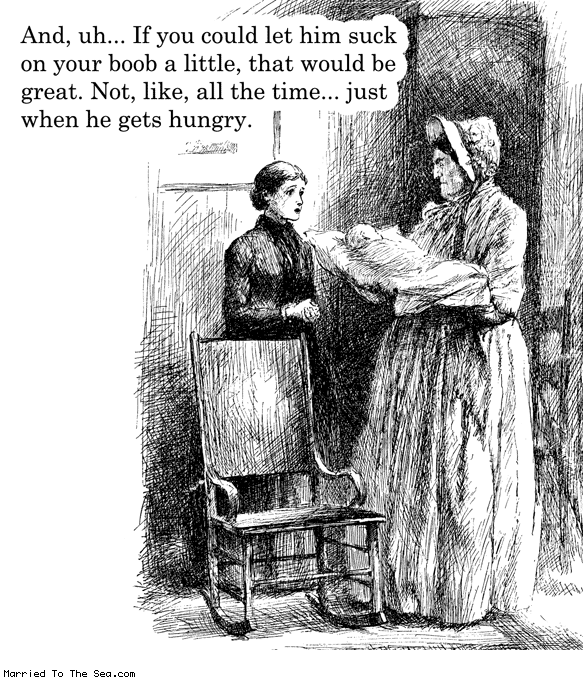
There are lots more!
Wednesday, July 13, 2011
What every doula should know about breastfeeding: Tip #1: Hand expression
I've learned a number of things as an LC that I wish I had known earlier as a doula, and that I would like to share with other doulas! I've decided to do a mini-series of tips called "What every doula should know about breastfeeding". All doulas get basic training in breastfeeding (and doulas are an evidence-based way to increase breastfeeding rates!) Doulas are generally excellent supports for helping normal breastfeeding get off to a good start. But often as a doula, before I became an LC, I would encounter situations in the hours after the baby was born, or at postpartum visits, where I wasn't quite sure what to suggest; or looking back, I realize I could have done something differently. I've decided to share some tips with other doulas about things that I wish I had known long ago!
A disclaimer: my breastfeeding tips for doulas aren't meant to turn you into an LC, or offer the same support as an LC does - one of my tips is going to be how to know when to refer to an LC and how to help your doula clients find advanced breastfeeding support (and you will find suggestions to refer to an LC liberally sprinkled throughout the tips as well!) They are meant to help you become a doula who is better at supporting breastfeeding in the doula role, and filling in some of the gaps in breastfeeding education and support that sadly still exist in our system.
So without further ado, the first tip of the series is... hand expression!
I had kinda sorta heard about hand expression before I became an LC. I knew you could theoretically express milk without a pump, but I confess to having wondered why you would WANT to. Couldn't a pump do the same thing, but faster and easier?
Now I teach hand expression on a daily basis, and I find it an incredibly useful tool. Yet many postpartum nurses, and even some LCs, don't know how to teach mothers how to hand express or when it can be useful. A knowledgeable doula can help fill that gap by recognizing when hand expression might be helpful and helping the mother learn how to do it.
WHEN and WHY to help with hand expression:
When are times that, as a doula, you might help a mother begin hand expression? Here are a few that I can think of:
1) The baby who doesn't latch. All doulas should have the training to help the mother get started breastfeeding just after birth, when the baby is most awake and alert. But sometimes, even with assistance, that first latch doesn't go as smoothly as we would like. The baby bobs around, mouths the nipple, pops on and off, or fusses at the breast and doesn't latch. Some babies just aren't ready to feed right away; for example, babies born with a vacuum-assist often seem to have trouble getting their suck organized at first, or a baby whose mother has had IV medication soon before the birth may be sleepy and not interested in latching.
Once that initial period of wakefulness has passed, the baby often falls into a deep sleep for hours and only wakes to feed a few times during the first day. Like so many breastfeeding "problems", it's not an actual problem for the baby, but it tends to cause anxiety for the parents and sometimes also prompts suggestions of supplementation from the medical staff. Sometimes the mother asks for a pump and is discouraged to see that after 15 minutes of pumping, all she has on the pump flange is a drop or two of colostrum. She starts to wonder if she really has any milk at all. If the baby is still struggling to latch, the next step is often a bottle, even when the mother really wanted to avoid formula, and the bottle can further compromise the baby's ability to latch.
If your doula client's baby hasn't latched by the time you leave, try teaching her hand expression so she has an alternative way to feed her baby. Pumps generally don't get out much colostrum compared to hand expression; a mother who pumps for 15 minutes to get a single drop can easily fill a teaspoon in a couple of minutes by hand expressing (and remember, a one-day-old baby's tummy is only made to hold a couple of teaspoons). All she needs is a plastic spoon from her meal tray to express into; when she's got a little colostrum in the spoon, she can spoon feed it to the baby or simply let the baby lick or suck drops off of her finger. A couple spoon feedings often reassure the mother and the nurse that the baby is taking food in, and give the baby time to rest and get ready to start latching and eating. When you leave the hospital after the birth and you know breastfeeding's not off to the perfect start, you can feel more confident that breastfeeding will ultimately go well if you've given the mom this tool to use.
2) Engorgement. This is particularly important for mothers who have had a highly interventive birth with lots of IV fluids - long inductions, many hours with an epidural, a c-section. These mothers tend to end up fluid-overloaded and their breasts fill up with extra fluid as well. When their milk comes in, they may have lumpy, hard, painful breasts that feel like they're full of milk, but only be able to pump a few drops. When you do your postpartum visit, you may discover this situation along with a very uncomfortable and unhappy mother.
I explain to these moms that they can think of their situation like this: There are a hundred people in a room, and they're all trying to get out one narrow door. They all pack around the door and squeeze up against it and there's just no room to open the door. We need to push some of the people away from the door so things can flow more freely. The breast is the room, and the people are the milk and intracellular fluid built up in her breasts. The pump may just pull more and more "people" towards the door. Instead, have her push back on her areolas for a few minutes to soften them (known as reverse pressure softening, with an excellent explanation and illustration here), then gently use hand expression to push a few "people" at a time towards the door. She can express into a bottle or cup to save the milk. Once the breast is somewhat softened, sometimes you can start the electric pump again, but sometimes you need to keep hand expressing for several sessions before the mother is able to pump.
I helped a mom like this recently. She was so engorged it took her an HOUR to soften a single breast with hand expression, but she got two and a half ounces when she was done! She said that neither the pump nor the baby had gotten more than a few drops since her milk came in. When I left she was starting the slow process of getting two+ ounces out of the other side, but at least she was able to move the milk out, get comfortable, and offer breastmilk to her baby.
I have never forgotten the big bold sentence in my breastfeeding educator training book that said "Unresolved engorgement is a breastfeeding emergency!!!" Unresolved engorgement can cause mastitis, compromise a mother's milk supply, and lead to nipple trauma if the baby is no longer latching well on the overfull breast. Hand expression can be a vital tool for working through severe engorgement. Be especially alert to the possibility of severe engorgement when you have seen a lot of IV fluids go into the mom and notice that her hands and feet are very puffy from the fluid retention; check in with her about her engorgement when you talk to her after the birth. If she is engorged and only getting advice to pump, pump, pump and not having much success, suggest hand expression as an alternative; and help her find a lactation consultant ASAP who can help her with issues that may be contributing to or caused by her engorgement.
3) NICU moms. Remember how I mentioned above that pumps are often not very effective at getting out colostrum? This is by far the most discouraging for the NICU mom whose baby is not able to go to breast due to prematurity or other medical complications. These moms may pump and pump and get almost nothing! Days of pumping a few drops at every pumping session are also discouraging and can lead the mom to cut back on her regular pumping schedule, which can compromise her supply. And the baby misses out on much of the colostrum which is one of the best medicines available!
There is also some preliminary research from Dr. Jane Morton at Stanford University showing that "hands-on" pumping and hand expression after pumping can increase the supply of mothers who are exclusively pumping. This is so important for NICU mothers who so frequently struggle with supply!
If you work with a mother whose baby goes to the NICU after birth, help advocate for her by requesting a pump right away. Help her get set up with the pump and use it for 10-15 minutes. Then show her how to hand express afterwards. Ask for a very small container to express into - we use little vials that are just 10 ml. Much less is lost that way and the mother can really see that in comparison to her baby's tummy, she's actually getting a pretty big meal! Encourage your client to follow every pumping session with hand expression. If the pump is slow to arrive, encourage her to go ahead and hand express every 3 hours - don't wait to start until the pump arrives! The earlier she starts, the better for her supply.
HOW to teach hand expression:
Okay, so hand expression is great and all, but how do you DO it?
Hand expression is a learned skill, and not one I learned especially quickly, so be patient and encourage your doula clients to be patient as well.
The single best tool I have seen for learning and teaching hand expression is this video from Stanford's Newborn Nursery (featuring Dr. Morton who is doing the research on hand expression and increased supply!) Watch it - multiple times - and practice the technique on yourself or on a cloth breast model. When teaching, try to find a way for your doula clients to watch it as well - they may have brought a laptop with them, or there might be a computer in the room. (And tell me if you can figure out a way to get it to work on a smartphone.) If you can't have her watch the video, demonstrate (discreetly) on yourself, use a breast model (or even a soft pillow!), or offer with her permission to demonstrate directly on her breast.
The main tips I have for teaching hand expression, which are also highlighted in the video, are to help the mother keep her fingers well back from the areola. The instinctive thing to do seems to be to spread the fingers apart, and then squeeze in right up to the nipple, often pulling the nipple far forward. This generally makes the mother sore and doesn't get her much milk for her effort. If it's helpful, place your hand over hers as she practices and repeat the rhythm of "press, compress, relax" while keeping the fingers in the same place on her breast. That said, if the mother finds an easy comfortable way to express milk, and it's not the "right" way, she should do whatever is working for her and her body.
Sometimes the mother will report soreness or tenderness in the breast when I am trying to teach her how to hand express hands-on, even when I'm trying to be as gentle as possible. When that happens, I suggest the mother be the only person to do the hand expression. It is usually much more comfortable when she is the one doing the compressions on herself.
It's also normal to have some mothers who can easily hand express a lot of colostrum, and some who, even with good technique, still barely get a drop. Encourage the mother to keep practicing and to be patient. Reassure the mother that hands are better than pumps, but NOTHING is designed to get milk out like a baby! The colostrum IS there, and when her baby is ready to latch on well, it will flow. Hand expression is NOT a test to see "if there's anything there" - it's just a tool to see whether in the absence of the baby, we can still get more milk out and stimulate a better supply.
I hope you and your doula clients find this helpful! Please comment with thoughts and if you have had situations where you think hand expression would have been helpful, and if there are other scenarios in which you think your clients might use it.
A disclaimer: my breastfeeding tips for doulas aren't meant to turn you into an LC, or offer the same support as an LC does - one of my tips is going to be how to know when to refer to an LC and how to help your doula clients find advanced breastfeeding support (and you will find suggestions to refer to an LC liberally sprinkled throughout the tips as well!) They are meant to help you become a doula who is better at supporting breastfeeding in the doula role, and filling in some of the gaps in breastfeeding education and support that sadly still exist in our system.
So without further ado, the first tip of the series is... hand expression!
I had kinda sorta heard about hand expression before I became an LC. I knew you could theoretically express milk without a pump, but I confess to having wondered why you would WANT to. Couldn't a pump do the same thing, but faster and easier?
Now I teach hand expression on a daily basis, and I find it an incredibly useful tool. Yet many postpartum nurses, and even some LCs, don't know how to teach mothers how to hand express or when it can be useful. A knowledgeable doula can help fill that gap by recognizing when hand expression might be helpful and helping the mother learn how to do it.
WHEN and WHY to help with hand expression:
When are times that, as a doula, you might help a mother begin hand expression? Here are a few that I can think of:
1) The baby who doesn't latch. All doulas should have the training to help the mother get started breastfeeding just after birth, when the baby is most awake and alert. But sometimes, even with assistance, that first latch doesn't go as smoothly as we would like. The baby bobs around, mouths the nipple, pops on and off, or fusses at the breast and doesn't latch. Some babies just aren't ready to feed right away; for example, babies born with a vacuum-assist often seem to have trouble getting their suck organized at first, or a baby whose mother has had IV medication soon before the birth may be sleepy and not interested in latching.
Once that initial period of wakefulness has passed, the baby often falls into a deep sleep for hours and only wakes to feed a few times during the first day. Like so many breastfeeding "problems", it's not an actual problem for the baby, but it tends to cause anxiety for the parents and sometimes also prompts suggestions of supplementation from the medical staff. Sometimes the mother asks for a pump and is discouraged to see that after 15 minutes of pumping, all she has on the pump flange is a drop or two of colostrum. She starts to wonder if she really has any milk at all. If the baby is still struggling to latch, the next step is often a bottle, even when the mother really wanted to avoid formula, and the bottle can further compromise the baby's ability to latch.
If your doula client's baby hasn't latched by the time you leave, try teaching her hand expression so she has an alternative way to feed her baby. Pumps generally don't get out much colostrum compared to hand expression; a mother who pumps for 15 minutes to get a single drop can easily fill a teaspoon in a couple of minutes by hand expressing (and remember, a one-day-old baby's tummy is only made to hold a couple of teaspoons). All she needs is a plastic spoon from her meal tray to express into; when she's got a little colostrum in the spoon, she can spoon feed it to the baby or simply let the baby lick or suck drops off of her finger. A couple spoon feedings often reassure the mother and the nurse that the baby is taking food in, and give the baby time to rest and get ready to start latching and eating. When you leave the hospital after the birth and you know breastfeeding's not off to the perfect start, you can feel more confident that breastfeeding will ultimately go well if you've given the mom this tool to use.
2) Engorgement. This is particularly important for mothers who have had a highly interventive birth with lots of IV fluids - long inductions, many hours with an epidural, a c-section. These mothers tend to end up fluid-overloaded and their breasts fill up with extra fluid as well. When their milk comes in, they may have lumpy, hard, painful breasts that feel like they're full of milk, but only be able to pump a few drops. When you do your postpartum visit, you may discover this situation along with a very uncomfortable and unhappy mother.
I explain to these moms that they can think of their situation like this: There are a hundred people in a room, and they're all trying to get out one narrow door. They all pack around the door and squeeze up against it and there's just no room to open the door. We need to push some of the people away from the door so things can flow more freely. The breast is the room, and the people are the milk and intracellular fluid built up in her breasts. The pump may just pull more and more "people" towards the door. Instead, have her push back on her areolas for a few minutes to soften them (known as reverse pressure softening, with an excellent explanation and illustration here), then gently use hand expression to push a few "people" at a time towards the door. She can express into a bottle or cup to save the milk. Once the breast is somewhat softened, sometimes you can start the electric pump again, but sometimes you need to keep hand expressing for several sessions before the mother is able to pump.
I helped a mom like this recently. She was so engorged it took her an HOUR to soften a single breast with hand expression, but she got two and a half ounces when she was done! She said that neither the pump nor the baby had gotten more than a few drops since her milk came in. When I left she was starting the slow process of getting two+ ounces out of the other side, but at least she was able to move the milk out, get comfortable, and offer breastmilk to her baby.
I have never forgotten the big bold sentence in my breastfeeding educator training book that said "Unresolved engorgement is a breastfeeding emergency!!!" Unresolved engorgement can cause mastitis, compromise a mother's milk supply, and lead to nipple trauma if the baby is no longer latching well on the overfull breast. Hand expression can be a vital tool for working through severe engorgement. Be especially alert to the possibility of severe engorgement when you have seen a lot of IV fluids go into the mom and notice that her hands and feet are very puffy from the fluid retention; check in with her about her engorgement when you talk to her after the birth. If she is engorged and only getting advice to pump, pump, pump and not having much success, suggest hand expression as an alternative; and help her find a lactation consultant ASAP who can help her with issues that may be contributing to or caused by her engorgement.
3) NICU moms. Remember how I mentioned above that pumps are often not very effective at getting out colostrum? This is by far the most discouraging for the NICU mom whose baby is not able to go to breast due to prematurity or other medical complications. These moms may pump and pump and get almost nothing! Days of pumping a few drops at every pumping session are also discouraging and can lead the mom to cut back on her regular pumping schedule, which can compromise her supply. And the baby misses out on much of the colostrum which is one of the best medicines available!
There is also some preliminary research from Dr. Jane Morton at Stanford University showing that "hands-on" pumping and hand expression after pumping can increase the supply of mothers who are exclusively pumping. This is so important for NICU mothers who so frequently struggle with supply!
If you work with a mother whose baby goes to the NICU after birth, help advocate for her by requesting a pump right away. Help her get set up with the pump and use it for 10-15 minutes. Then show her how to hand express afterwards. Ask for a very small container to express into - we use little vials that are just 10 ml. Much less is lost that way and the mother can really see that in comparison to her baby's tummy, she's actually getting a pretty big meal! Encourage your client to follow every pumping session with hand expression. If the pump is slow to arrive, encourage her to go ahead and hand express every 3 hours - don't wait to start until the pump arrives! The earlier she starts, the better for her supply.
HOW to teach hand expression:
Okay, so hand expression is great and all, but how do you DO it?
Hand expression is a learned skill, and not one I learned especially quickly, so be patient and encourage your doula clients to be patient as well.
The single best tool I have seen for learning and teaching hand expression is this video from Stanford's Newborn Nursery (featuring Dr. Morton who is doing the research on hand expression and increased supply!) Watch it - multiple times - and practice the technique on yourself or on a cloth breast model. When teaching, try to find a way for your doula clients to watch it as well - they may have brought a laptop with them, or there might be a computer in the room. (And tell me if you can figure out a way to get it to work on a smartphone.) If you can't have her watch the video, demonstrate (discreetly) on yourself, use a breast model (or even a soft pillow!), or offer with her permission to demonstrate directly on her breast.
The main tips I have for teaching hand expression, which are also highlighted in the video, are to help the mother keep her fingers well back from the areola. The instinctive thing to do seems to be to spread the fingers apart, and then squeeze in right up to the nipple, often pulling the nipple far forward. This generally makes the mother sore and doesn't get her much milk for her effort. If it's helpful, place your hand over hers as she practices and repeat the rhythm of "press, compress, relax" while keeping the fingers in the same place on her breast. That said, if the mother finds an easy comfortable way to express milk, and it's not the "right" way, she should do whatever is working for her and her body.
Sometimes the mother will report soreness or tenderness in the breast when I am trying to teach her how to hand express hands-on, even when I'm trying to be as gentle as possible. When that happens, I suggest the mother be the only person to do the hand expression. It is usually much more comfortable when she is the one doing the compressions on herself.
It's also normal to have some mothers who can easily hand express a lot of colostrum, and some who, even with good technique, still barely get a drop. Encourage the mother to keep practicing and to be patient. Reassure the mother that hands are better than pumps, but NOTHING is designed to get milk out like a baby! The colostrum IS there, and when her baby is ready to latch on well, it will flow. Hand expression is NOT a test to see "if there's anything there" - it's just a tool to see whether in the absence of the baby, we can still get more milk out and stimulate a better supply.
I hope you and your doula clients find this helpful! Please comment with thoughts and if you have had situations where you think hand expression would have been helpful, and if there are other scenarios in which you think your clients might use it.
Thursday, June 16, 2011
What's different about being a doula outside of the hospital?
When I posted about attending my first home birth, one commenter asked:
"As a doula did you feel that your role was very different? I had both of my children at home; looking back I wish I had a doula. My midwives, are amazing but they are very hands off and quiet. I think a little more direct verbal support could have greatly shortened both of my labors."
I have been thinking about my response to that comment since attending another out-of-hospital birth and another hospital birth since then. Below are some thoughts, some of which were included in my reply to the original comment:
It has been most interesting to experience the feeling of having to do zero "defense", to not even have to prepare myself for the possibility of running interference. When all of a sudden I no longer had to have my guard up, I realized how much energy and attention I was spending on it. I didn't have to tense myself to find out if the next nurse or OB or midwife on shift was friendly or hostile, flexible or rules-obsessed. I didn't have to explain any birth plans to nurses or nag anyone to get the monitors off or try to soften the impact of discouraging words. I didn't have to help navigate decisions where the woman couldn't be sure whether she should trust her caregivers' recommendation. And in terms of my role, I knew I was totally welcomed and my role was perfectly understood by the midwives there. It was amazing just to toss all that defense aside, know that both the families and I were in a place they could trust, and be 100% focused on labor support.
I also felt very confident that I could let the midwives take over the role of suggesting position changes, etc. when they were around - that was a new feeling. Sometimes in the hospital, I feel like I am the only one taking responsibility for suggesting proactive things to progress labor, ensure optimal fetal positioning, etc., and again I am always on guard that those will be met with negative feedback by the nurses ("what's she doing on the TOILET?") or resistance by the mom ("do I have to move??") Outside of the hospital, the midwives were on top of that stuff, and they had the trust and authority to say "It's really important and I think it would help you, let's get you walking again". I sometimes suggested things as well if I sensed it was the right moment, but I never worried that I would be the only one or that the midwives would be reluctant to try anything the mom was up for.
So I would say the main difference has been in feeling real trust and confidence in the caregivers - that they were on exactly the same page as the family, that they had and used skills that I consider very important, and that everyone who would be there throughout the labor and birth would share those goals and skills.
While one of the reasons I encourage everyone to have a doula for a hospital birth - that guard/buffer role - was not necessary for the out-of-hospital births, I look back and think how much that freed me up to simply focus on the woman and fulfill all the other parts of my doula role. I think a helpful role that I played was in being there before it was time for the midwives to arrive: encouraging rest, suggesting position changes, giving feedback on where I thought labor was at, helping get the tub set up, etc. Many people are ready for some trained labor support before they're really ready to call the midwives. And after they got there I was still doing verbal support/encouragement, taking turns doing counterpressure, and of course the "gofer" role that doulas do so well. And like the commenter mentioned, sometimes your midwives give you wonderful care but their labor support is just not the kind that helps you the most. I would encourage anyone to have a doula at a home birth!
"As a doula did you feel that your role was very different? I had both of my children at home; looking back I wish I had a doula. My midwives, are amazing but they are very hands off and quiet. I think a little more direct verbal support could have greatly shortened both of my labors."
I have been thinking about my response to that comment since attending another out-of-hospital birth and another hospital birth since then. Below are some thoughts, some of which were included in my reply to the original comment:
It has been most interesting to experience the feeling of having to do zero "defense", to not even have to prepare myself for the possibility of running interference. When all of a sudden I no longer had to have my guard up, I realized how much energy and attention I was spending on it. I didn't have to tense myself to find out if the next nurse or OB or midwife on shift was friendly or hostile, flexible or rules-obsessed. I didn't have to explain any birth plans to nurses or nag anyone to get the monitors off or try to soften the impact of discouraging words. I didn't have to help navigate decisions where the woman couldn't be sure whether she should trust her caregivers' recommendation. And in terms of my role, I knew I was totally welcomed and my role was perfectly understood by the midwives there. It was amazing just to toss all that defense aside, know that both the families and I were in a place they could trust, and be 100% focused on labor support.
I also felt very confident that I could let the midwives take over the role of suggesting position changes, etc. when they were around - that was a new feeling. Sometimes in the hospital, I feel like I am the only one taking responsibility for suggesting proactive things to progress labor, ensure optimal fetal positioning, etc., and again I am always on guard that those will be met with negative feedback by the nurses ("what's she doing on the TOILET?") or resistance by the mom ("do I have to move??") Outside of the hospital, the midwives were on top of that stuff, and they had the trust and authority to say "It's really important and I think it would help you, let's get you walking again". I sometimes suggested things as well if I sensed it was the right moment, but I never worried that I would be the only one or that the midwives would be reluctant to try anything the mom was up for.
So I would say the main difference has been in feeling real trust and confidence in the caregivers - that they were on exactly the same page as the family, that they had and used skills that I consider very important, and that everyone who would be there throughout the labor and birth would share those goals and skills.
While one of the reasons I encourage everyone to have a doula for a hospital birth - that guard/buffer role - was not necessary for the out-of-hospital births, I look back and think how much that freed me up to simply focus on the woman and fulfill all the other parts of my doula role. I think a helpful role that I played was in being there before it was time for the midwives to arrive: encouraging rest, suggesting position changes, giving feedback on where I thought labor was at, helping get the tub set up, etc. Many people are ready for some trained labor support before they're really ready to call the midwives. And after they got there I was still doing verbal support/encouragement, taking turns doing counterpressure, and of course the "gofer" role that doulas do so well. And like the commenter mentioned, sometimes your midwives give you wonderful care but their labor support is just not the kind that helps you the most. I would encourage anyone to have a doula at a home birth!
Friday, June 10, 2011
How people find my blog, June edition
I wasn't planning to do one of these again so soon, but looking through the list of search terms used en route to Public Health Doula just offered too many opportunities to resist. How have people been finding my blog this month? Let's see:
"public health boring"
Well, sometimes. Sorry, stroke prevention...I just can't get excited about you, as important as you are, but I'm sure the stroke prevention people find my work boring too, so I'm happy we've all found our bliss.
"documentary how do you know when a molly is about to give birth"
Is a "molly" some kind of animal? Or this just specifically for women named Molly? And there's a whole documentary about them?
"i want to breastfeed buy nicu has my baby on bottle what should i do"
This makes me sad because I see it so often. Short answer: Demand a visit with a lactation consultant, and if the hospital doesn't have any find an outside IBCLC who can help you. Join a La Leche League group for support, and stay committed - time and patience can do a lot in this situation.
"baby friendly initiative bullshit"
I'm assuming this was a search done by a bitter postpartum floor nurse. I think I might know a few of them. Sorry you're not a fan of evidence-based practices!
"how should you supplement a hypoglycemic baby"
Depends on the hypoglycemia and the baby, but in many situations the first choice should always be breastfeeding/the mother's own milk!
"hate directed pushing"
Me too!!!
"barbie doula"
Oh my god, I can't wait for Doula Barbie! Let's figure out an outfit for her. I'm thinking her accessories should definitely include a birth ball, a rice sock, and a tiny copy of "The Labor Progress Handbook".
"public health boring"
Well, sometimes. Sorry, stroke prevention...I just can't get excited about you, as important as you are, but I'm sure the stroke prevention people find my work boring too, so I'm happy we've all found our bliss.
"documentary how do you know when a molly is about to give birth"
Is a "molly" some kind of animal? Or this just specifically for women named Molly? And there's a whole documentary about them?
"i want to breastfeed buy nicu has my baby on bottle what should i do"
This makes me sad because I see it so often. Short answer: Demand a visit with a lactation consultant, and if the hospital doesn't have any find an outside IBCLC who can help you. Join a La Leche League group for support, and stay committed - time and patience can do a lot in this situation.
"baby friendly initiative bullshit"
I'm assuming this was a search done by a bitter postpartum floor nurse. I think I might know a few of them. Sorry you're not a fan of evidence-based practices!
"how should you supplement a hypoglycemic baby"
Depends on the hypoglycemia and the baby, but in many situations the first choice should always be breastfeeding/the mother's own milk!
"hate directed pushing"
Me too!!!
"barbie doula"
Oh my god, I can't wait for Doula Barbie! Let's figure out an outfit for her. I'm thinking her accessories should definitely include a birth ball, a rice sock, and a tiny copy of "The Labor Progress Handbook".
Thursday, June 9, 2011
Becoming a better doula...through the power of the INTERNET!
When I first became a doula, I didn't know about many online resources for doulas; I don't know if they were even very common at that point. In terms of my continuing education as a doula, I learned from books, talking with doulas, midwives, and nurses, and of course hands-on from attending births! After taking a couple years' break from serious doula-ing, though, I was getting back into it, looking for more resources, and found a number of doula-related sites and listservs. Then I started reading blogs and discovered an even bigger world of blogs and resources.
In-person networking and sharing are still important, but I have learned so much from online resources that I almost think joining a single doula forum or listserv, at the very least, should be a requirement for being a doula. I am often surprised, in fact, by how little some doulas know about topics that I have seen extensively discussed in various online settings. We have a responsibility to ourselves and our clients to stay current with changes in maternity care practices, new research, and current events in the birth-o-sphere. So much of that is easily available online. And practicing solo, sometimes in hostile or isolated settings, can make it very difficult to generate the kind of community and collegial settings where doulas can share information and learn from each other. I have learned so much, and deepened my thinking, from reading information and debates on testing, interventions, informed consent, the doula's role, and more by participating in listservs and through the many great blogs by doulas, midwives, nurses, and other people interested in and passionate about birth.
That isn't to say every doula should become a blog junkie like me, though! Simply joining your local doula listserv often sends news items and discussion through your inbox, as well as connecting you to the local birth network. Usually those listservs will have "digest" settings so you can get all the messages sent each day packaged together in one e-mail. (I am already drowning in e-mail, so I set all listservs to arrive as digests or my inbox would be out of control!) If you don't have a good local listserv, I recommend Alldoulas.com where you can both connect with local people and interact with doulas from all over the world. I don't go on there very often, but the forums have been friendly, helpful, and a great resource for me when I needed them.
If you DO want to become a blog junkie like me (or just find a few good blogs to follow), I've created a "bundle" of my favorite blogs for those of you who use Google Reader. Click here to easily see and subscribe to all or some.
I should also say that I have also benefited hugely from the online resources available for communication among IBCLCs, specifically Lactnet. Reading about puzzling or complicated cases, the different takes of LCs from around the world on those cases or on issues of ethics and professional responsibility, and learning new tips and tricks has been fantastic and so educational. I sometimes see advice or techniques for situations I've encountered, and I print out them out and keep them on my clipboard at work in case I need them. (For example, I recently had great success with advice for how best to use reverse pressure softening with a very edematous mother.) As a new IBCLC, I know I have a huge amount left to learn and reading Lactnet is like getting to peer over the shoulder of more experienced LCs as they think and work with moms/babies.
What are your favorite doula/birthworker online supports or resources?
In-person networking and sharing are still important, but I have learned so much from online resources that I almost think joining a single doula forum or listserv, at the very least, should be a requirement for being a doula. I am often surprised, in fact, by how little some doulas know about topics that I have seen extensively discussed in various online settings. We have a responsibility to ourselves and our clients to stay current with changes in maternity care practices, new research, and current events in the birth-o-sphere. So much of that is easily available online. And practicing solo, sometimes in hostile or isolated settings, can make it very difficult to generate the kind of community and collegial settings where doulas can share information and learn from each other. I have learned so much, and deepened my thinking, from reading information and debates on testing, interventions, informed consent, the doula's role, and more by participating in listservs and through the many great blogs by doulas, midwives, nurses, and other people interested in and passionate about birth.
That isn't to say every doula should become a blog junkie like me, though! Simply joining your local doula listserv often sends news items and discussion through your inbox, as well as connecting you to the local birth network. Usually those listservs will have "digest" settings so you can get all the messages sent each day packaged together in one e-mail. (I am already drowning in e-mail, so I set all listservs to arrive as digests or my inbox would be out of control!) If you don't have a good local listserv, I recommend Alldoulas.com where you can both connect with local people and interact with doulas from all over the world. I don't go on there very often, but the forums have been friendly, helpful, and a great resource for me when I needed them.
If you DO want to become a blog junkie like me (or just find a few good blogs to follow), I've created a "bundle" of my favorite blogs for those of you who use Google Reader. Click here to easily see and subscribe to all or some.
I should also say that I have also benefited hugely from the online resources available for communication among IBCLCs, specifically Lactnet. Reading about puzzling or complicated cases, the different takes of LCs from around the world on those cases or on issues of ethics and professional responsibility, and learning new tips and tricks has been fantastic and so educational. I sometimes see advice or techniques for situations I've encountered, and I print out them out and keep them on my clipboard at work in case I need them. (For example, I recently had great success with advice for how best to use reverse pressure softening with a very edematous mother.) As a new IBCLC, I know I have a huge amount left to learn and reading Lactnet is like getting to peer over the shoulder of more experienced LCs as they think and work with moms/babies.
What are your favorite doula/birthworker online supports or resources?
Tuesday, May 3, 2011
Living as a doula, making a living as a doula, and life without doula-ing
When I heard Penny Simkin speak at the Breastfeeding & Feminism conference, she talked about the rising fees that doulas are charging and the conflict between doulas who do it for a living and doulas who do it as sideline income or even without any real financial need/goals. I've almost never met a doula who can support themselves on doula work alone, but Penny Simkin was talking about how for an increasing number of doulas this is their goal. They love doula work and they want to charge fees that enable them to support themselves/their families on their doula career alone.
For a little while I had the idea that I could be one of those doulas...I gave that up pretty fast. I realized how long it would take to build a consistent referral base to bring in new clients and how even when you think you've got a good cycle going, things happen... many doulas I knew in NYC were really impacted by the economic downturn there, when fewer parents felt financially able/willing to spend on doulas (you all know I think that's one of the most important things to spend on, but those parents didn't ask me!) I also saw how most doulas needed other sources of income to fallback on: many offer a whole set of services like childbirth ed, placenta encapsulation, birth photography, etc. etc. I'm not a personality who is happy patching things together that way long-term, and it didn't seem like it made sense for my personal financial health either. I decided to go back to grad school and get me a Real Grown-Up Job (tm).
Fast-forward to my Real Grown-Up Job (tm) doing something I love - working as an LC - and I am now feeling the tug between my doula work and said Real Job. I attended my second out-of-hospital birth ever today - hooray! It went so well and was such a wonderful experience with a lovely family. It really reminded me of why I LOVE being a doula - why it is my favorite thing in the world to do. But it was hard to work it around the Real Job in ways that show it really wouldn't be sustainable in the long-term to take doula clients. When I'm in the midst of being on-call for clients - phone always on and with me, can't go out of town, can't make concrete plans, etc. - it doesn't seem like such a sacrifice. But then I go to a birth, all those little annoyances fall away, and it breaks my heart to think about stopping.
I have thought about doing a partner doula system, where clients hire me & another doula together with the understanding that one of us is always on-call and at birthing time she could get either one, depending on our schedules. But it has been frustratingly difficult for me to find back-up doulas, and I don't really think that bodes well for finding a full-time partner. There might be some more flexibility in going back to volunteer doula work, but I recognize that will need to be fairly rare; I found myself getting burned out on 30+ hour volunteer births where I wasn't willing to leave but wasn't feeling a return on my energy and experience.
I have one more doula client coming up (yep, still on call!) Both today's and the next one hired me before I went permanent at Real Job. After that, I know I'll be happy to get some time off from the on-call routine...and then what?
For a little while I had the idea that I could be one of those doulas...I gave that up pretty fast. I realized how long it would take to build a consistent referral base to bring in new clients and how even when you think you've got a good cycle going, things happen... many doulas I knew in NYC were really impacted by the economic downturn there, when fewer parents felt financially able/willing to spend on doulas (you all know I think that's one of the most important things to spend on, but those parents didn't ask me!) I also saw how most doulas needed other sources of income to fallback on: many offer a whole set of services like childbirth ed, placenta encapsulation, birth photography, etc. etc. I'm not a personality who is happy patching things together that way long-term, and it didn't seem like it made sense for my personal financial health either. I decided to go back to grad school and get me a Real Grown-Up Job (tm).
Fast-forward to my Real Grown-Up Job (tm) doing something I love - working as an LC - and I am now feeling the tug between my doula work and said Real Job. I attended my second out-of-hospital birth ever today - hooray! It went so well and was such a wonderful experience with a lovely family. It really reminded me of why I LOVE being a doula - why it is my favorite thing in the world to do. But it was hard to work it around the Real Job in ways that show it really wouldn't be sustainable in the long-term to take doula clients. When I'm in the midst of being on-call for clients - phone always on and with me, can't go out of town, can't make concrete plans, etc. - it doesn't seem like such a sacrifice. But then I go to a birth, all those little annoyances fall away, and it breaks my heart to think about stopping.
I have thought about doing a partner doula system, where clients hire me & another doula together with the understanding that one of us is always on-call and at birthing time she could get either one, depending on our schedules. But it has been frustratingly difficult for me to find back-up doulas, and I don't really think that bodes well for finding a full-time partner. There might be some more flexibility in going back to volunteer doula work, but I recognize that will need to be fairly rare; I found myself getting burned out on 30+ hour volunteer births where I wasn't willing to leave but wasn't feeling a return on my energy and experience.
I have one more doula client coming up (yep, still on call!) Both today's and the next one hired me before I went permanent at Real Job. After that, I know I'll be happy to get some time off from the on-call routine...and then what?
Thursday, April 28, 2011
AmeriCorps doula job posting
As I noted in my post on AmeriCorps doula opportunities, I don't generally have any info about what's currently out there. AmeriCorps programs and positions are constantly changing and I don't even know what's happening with my old program, much less anyone else's! But I have a friend looking for AmeriCorps positions in Seattle right now and she sent me this posting:
Just reading the job description brought back such wonderful memories of my work as an AmeriCorps doula! I still describe that job as, hands down, the best job I ever had. If you're interested, go for it! (I promise my friend won't be competing with you... she's more interested in estuarine ecology.)
Member Duties : Two positions are offered for members who will train as a Birthing Doula with Seattle Midwifery School. Members will then serve as part of Seattle's MSS Department providing pre and post labor education as well as labor support to clients who lack a support system. This position requires independence, sensitivity, a willingness to work independently, and the ability to handle a demanding on-call schedule as well as bilingualism in Spanish and English. To learn more about the role of a Doula visit www.dona.org. IN ORDER TO COMPLETE YOUR AMERICORPS APPLICATION, PLEASE COMPLETE AND SUBMIT THE SUPPLEMENTAL QUESTIONS LOCATED ON THE SEA MAR WEBSITE. These questions can be found by clicking to www.seamar.org, then pulling down the menu "Jobs", clicking on "AmeriCorps" and clicking to "How To Apply".
Program Benefits :
Childcare assistance if eligible , Education award upon successful completion of service , Health Coverage , Living Allowance , Training .
Terms :
Permits attendance at school during off hours , Permits working at another job during off hours .
Service Areas :
Community Outreach , Education , Health
Just reading the job description brought back such wonderful memories of my work as an AmeriCorps doula! I still describe that job as, hands down, the best job I ever had. If you're interested, go for it! (I promise my friend won't be competing with you... she's more interested in estuarine ecology.)
Tuesday, October 12, 2010
Opportunities for doula work internationally?
It's ask-the-readers time! I recently got this e-mail from Leila:
I live in the Boston area and am currently in the process of becoming a doula. I also plan on getting my masters in public health soon after I finish college. Your blog brings me lot of hope and excitement as I wet my feet in the field of public health! Maybe you can offer me some advice- I'm trying to find ways of working/volunteering as a doula somewhere in the Third World and I can't find anything! Do you have ideas or know of organizations I could look into that might offer such positions?I had only one or two possible leads, and I have heard similar inquires in the past and not really known where to send people then either. Does anyone out there have suggestions for her?
Thursday, September 9, 2010
What makes a doula "experienced"?
I was talking with someone at a party last weekend who is in the midst of interviewing doulas. (Yes, I was voted "Most likely to talk about childbirth at a party" by my MCH cohort - what of it?) She wanted someone who was "experienced" and asked me how many births I thought made someone experienced. I was brought up short - truth to tell, I wasn't really sure. I thought well, I consider myself experienced - how many births have I been to? How many did it take before I felt more "experienced"?
I had kind of been losing track of the number of births I'd been to - I had them all recorded in one place or another, but hadn't been keeping a running total like I used to. I keep saying "oh, probably around 45" so I finally sat down and totaled them all up the other day. My accounting may still not be exact, but it looks like I've attended 42 births at this point.
So, 42: not bad at all - and I'm proud that those were a very diverse group of births: high- and low-risk, women from all backgrounds, with all kinds of birth plans (or no plan at all), with a range of different providers and settings. So I feel "experienced".
And yet I know I learn something new at every birth, and almost always think of something I wish I had done different; and I also know doulas who have attended hundreds of births. So maybe I'm only medium-experienced? And so how can I say exactly when I did cross the line from "novice" to "medium-experienced"? Ten births? Fifteen? Twenty?
On top of that, did I become a "better" doula when I became more "experienced"? Certainly my comfort and confidence have increased the more I've done this work, and I hope that both my greater confidence along with my growing knowledge and skills have helped my clients. But when so much of attending births as a doula has to do with "being" instead of "doing", there may not be that big a gap between me as a novice doula and me as an experienced doula as I think.
What do you think? Is an experienced doula important to you? Doulas, what differences do you see between your novice self and your more experienced self? Do you think there are any special strengths of being a novice doula at births?
I had kind of been losing track of the number of births I'd been to - I had them all recorded in one place or another, but hadn't been keeping a running total like I used to. I keep saying "oh, probably around 45" so I finally sat down and totaled them all up the other day. My accounting may still not be exact, but it looks like I've attended 42 births at this point.
So, 42: not bad at all - and I'm proud that those were a very diverse group of births: high- and low-risk, women from all backgrounds, with all kinds of birth plans (or no plan at all), with a range of different providers and settings. So I feel "experienced".
And yet I know I learn something new at every birth, and almost always think of something I wish I had done different; and I also know doulas who have attended hundreds of births. So maybe I'm only medium-experienced? And so how can I say exactly when I did cross the line from "novice" to "medium-experienced"? Ten births? Fifteen? Twenty?
On top of that, did I become a "better" doula when I became more "experienced"? Certainly my comfort and confidence have increased the more I've done this work, and I hope that both my greater confidence along with my growing knowledge and skills have helped my clients. But when so much of attending births as a doula has to do with "being" instead of "doing", there may not be that big a gap between me as a novice doula and me as an experienced doula as I think.
What do you think? Is an experienced doula important to you? Doulas, what differences do you see between your novice self and your more experienced self? Do you think there are any special strengths of being a novice doula at births?
Saturday, September 4, 2010
Score another one for the big babies!
I haven't had a lot of doula/birthy posts lately, probably not enough to justify the name of this blog! That's in part because I hadn't been to any births recently. But the past few weeks I've been waiting on two births, due about a week apart but of course delivered only about 24 hours apart. So it's been busy!
The second labor was definitely another score for the big babies. Fast labor, basically no pushing - more breathing the baby down while trying NOT to push (I was a little concerned baby might be born in the car, but I have yet to hit that doula milestone!) - and fast delivery. Well over nine pounds! The midwife said the shoulders were a little sticky but because mom was already on hands and knees (which she chose instinctively for labor and pushing), it all went very smoothly.
Let me say it again: Big babies can be born vaginally! They can be born quickly! They can be born easily! Don't trust scare tactics about a big baby - read the research, and hear the positive stories.
So now I am coming down off my post-two-births high and thankful to go off call for a little while. I know I'll start jonesing to attend another birth soon!
The second labor was definitely another score for the big babies. Fast labor, basically no pushing - more breathing the baby down while trying NOT to push (I was a little concerned baby might be born in the car, but I have yet to hit that doula milestone!) - and fast delivery. Well over nine pounds! The midwife said the shoulders were a little sticky but because mom was already on hands and knees (which she chose instinctively for labor and pushing), it all went very smoothly.
Let me say it again: Big babies can be born vaginally! They can be born quickly! They can be born easily! Don't trust scare tactics about a big baby - read the research, and hear the positive stories.
So now I am coming down off my post-two-births high and thankful to go off call for a little while. I know I'll start jonesing to attend another birth soon!
Monday, June 21, 2010
Doulas, what do you give your clients?
Another doula practice question! I'm working on a packet of info for future doula clients. I haven't done this before but it seems like a nice resource to give. I'd like them to have local breastfeeding resources (e.g. support groups), general parenting resources (e.g. organized playgroups, places to get low-cost services/baby needs), and a few info sheets from me - on things like writing the birth plan, thinking about your options in labor, etc. What else is helpful? Doulas, what do you give your clients (if anything)? If you've used a doula, what information did you get, or would have liked to get?
Wednesday, May 26, 2010
Public Health Doula, MPH
Family and friends and celebrations have come and gone, graduation is over, and I can now say that I officially have a Master's of Public Health!
To be honest, it feels a bit anti-climactic - my last semester was busy, but mostly with things besides academic work, particularly once my thesis was done at the beginning of April. Unlike the end of my undergrad degree, which was a relieved crossing-the-finish-line feeling, my graduate commencement was more of a "oh, hi finish line, I knew you'd be around here somewhere" feeling.
Still, I am happy and proud of my shiny new graduate degree, and I'm hoping to put it to good use in the near future...whatever form that takes. In the meantime, I want to take a moment to appreciate how much writing this blog, and reading/connecting with other blogs has been an amazing education in and of itself over the past two years. It's filled in some of the spaces a public health education doesn't address, when it comes to my own particular interests. I've learned how to monitor the heck out of a program in my MPH education, but I didn't have many opportunities to debate the nature of informed consent, hear stories from women who felt judged for formula feeding, or gauge how public health recommendations look to, and are interpreted by, the outside world.
I've also valued the opportunity to connect with like-minded people around the country and around the world. The issues of sex, reproduction, reproductive health, abortion, pregnancy, birth, breastfeeding, our agency as women over our own bodies...these are complex issues with many layers of thinking and learning to work through as we talk about them. Sometimes it feels frustrating to feel like you're starting over at "101" level every time you try to discuss them with someone new. I have been so lucky to find people who are already thinking about these issues and their interconnections, and can not just meet me where I'm at but push me further.
It's also deeply enriched my doula practice. I learn about new topics, techniques, research, and ways of thinking about and conveying information to others. More and more frequently, I find myself referring clients and friends to blogs and to blog posts for questions like understanding rising c-section rates or writing a birth plan. Sometimes I think the blog world should be required reading for new doulas (and other birth professionals!) It expands my worldview beyond what I just learn/hear in my training or from other people locally, and helps me contextualize doula practice in the bigger picture of birth issues and activism.
Finally, I have loved building a small but growing community of readers for my blog. Posting about wondering where to find doula clients and having so many wonderful and generous suggestions was such a help for me, and a boost to my confidence. I am so grateful to all of you who commented on that post, and to all of the readers and commenters out there!
I'm not sure what's next for me as a doula and a newly-minted MPH, but I'm excited to be starting work half-time next week at the hospital where I've been training to be an LC. They are hiring me temporarily as a "breastfeeding specialist" (since I'm not an LC yet), to do several night shifts of lactation support a week. This will be my first experience doing lactation support in the hospital solo, not to mention my first experience working nights (well, I've stayed up many nights as a doula but this seems a bit different!) I am excited and of course at least a little nervous, and interested to see where this leads.
I'm also not sure what's next for this blog - between graduation and traveling, it seems to be that just like last year, May has been a vacation month from blogging! And while it always seems like there are a dozen posts or news items a day popping up in my blog reader or news alerts that I could link to and talk about, it's seemed harder recently to actually get those into the blog. With a shift in my work and to some extent my focus, my posts may change too - more? less? different topics? We'll see!
I do plan to do a post soon on applying to and choosing an MPH program, since I have had several e-mails about that from readers and I would really like to help people understand more about the degree, what it can do for you, and what you should be thinking about when applying. As always, I am open to other requests for topics! Just comment, or e-mail, and let me know.
In the meantime, I hope you'll keep reading, and commenting, and linking, and e-mailing! Every time I check my subscriber stats, I do a little happy dance that more people are interested in what I have to say (because as anyone who knows me will tell you, I love to talk) and I hope that community keeps growing.
To be honest, it feels a bit anti-climactic - my last semester was busy, but mostly with things besides academic work, particularly once my thesis was done at the beginning of April. Unlike the end of my undergrad degree, which was a relieved crossing-the-finish-line feeling, my graduate commencement was more of a "oh, hi finish line, I knew you'd be around here somewhere" feeling.
Still, I am happy and proud of my shiny new graduate degree, and I'm hoping to put it to good use in the near future...whatever form that takes. In the meantime, I want to take a moment to appreciate how much writing this blog, and reading/connecting with other blogs has been an amazing education in and of itself over the past two years. It's filled in some of the spaces a public health education doesn't address, when it comes to my own particular interests. I've learned how to monitor the heck out of a program in my MPH education, but I didn't have many opportunities to debate the nature of informed consent, hear stories from women who felt judged for formula feeding, or gauge how public health recommendations look to, and are interpreted by, the outside world.
I've also valued the opportunity to connect with like-minded people around the country and around the world. The issues of sex, reproduction, reproductive health, abortion, pregnancy, birth, breastfeeding, our agency as women over our own bodies...these are complex issues with many layers of thinking and learning to work through as we talk about them. Sometimes it feels frustrating to feel like you're starting over at "101" level every time you try to discuss them with someone new. I have been so lucky to find people who are already thinking about these issues and their interconnections, and can not just meet me where I'm at but push me further.
It's also deeply enriched my doula practice. I learn about new topics, techniques, research, and ways of thinking about and conveying information to others. More and more frequently, I find myself referring clients and friends to blogs and to blog posts for questions like understanding rising c-section rates or writing a birth plan. Sometimes I think the blog world should be required reading for new doulas (and other birth professionals!) It expands my worldview beyond what I just learn/hear in my training or from other people locally, and helps me contextualize doula practice in the bigger picture of birth issues and activism.
Finally, I have loved building a small but growing community of readers for my blog. Posting about wondering where to find doula clients and having so many wonderful and generous suggestions was such a help for me, and a boost to my confidence. I am so grateful to all of you who commented on that post, and to all of the readers and commenters out there!
I'm not sure what's next for me as a doula and a newly-minted MPH, but I'm excited to be starting work half-time next week at the hospital where I've been training to be an LC. They are hiring me temporarily as a "breastfeeding specialist" (since I'm not an LC yet), to do several night shifts of lactation support a week. This will be my first experience doing lactation support in the hospital solo, not to mention my first experience working nights (well, I've stayed up many nights as a doula but this seems a bit different!) I am excited and of course at least a little nervous, and interested to see where this leads.
I'm also not sure what's next for this blog - between graduation and traveling, it seems to be that just like last year, May has been a vacation month from blogging! And while it always seems like there are a dozen posts or news items a day popping up in my blog reader or news alerts that I could link to and talk about, it's seemed harder recently to actually get those into the blog. With a shift in my work and to some extent my focus, my posts may change too - more? less? different topics? We'll see!
I do plan to do a post soon on applying to and choosing an MPH program, since I have had several e-mails about that from readers and I would really like to help people understand more about the degree, what it can do for you, and what you should be thinking about when applying. As always, I am open to other requests for topics! Just comment, or e-mail, and let me know.
In the meantime, I hope you'll keep reading, and commenting, and linking, and e-mailing! Every time I check my subscriber stats, I do a little happy dance that more people are interested in what I have to say (because as anyone who knows me will tell you, I love to talk) and I hope that community keeps growing.
Sunday, May 2, 2010
How do/did you look for a doula?
Graduation is quickly approaching - my master's thesis is completed, my classes are thisclose to finished, and soon, I'll be a real, live Master of Public Health (a master! doesn't that sound great?) Time to look for a job, right?
Well, timing is creating a bit of a wrinkle for me. While I'll have my MPH in May, the exam to become an International Board Certified Lactation Consultant (IBCLC) doesn't happen until July. And then it's another wait for the results. I'd like to be able to use that credential in my job search. So I'm hesitant to get desperate and commit to some job, any job, right away. All my job ponderings are another post for another day, but for now I'll say that I'm willing and able to hold out for a couple of months at least before committing to something full-time, long-term, in hopes that what I eventually commit to is up my alley (perinatal issues).
That of course does not mean that I won't be working; instead it means that I need to find more short-term and/or part-time work (a situation with which I am depressingly familiar, but yet again another post for another day). Right now, I'm lining up work to teach a prenatal breastfeeding class, possibly continue doing research assistant work for the department, and looking for more ways to bridge the gap - including trying to work as a private doula again.
I have some real blocks about looking for private doula work (did I mention something about other posts for other days?) but I'm trying to move past them and push myself to do some real marketing. I have an extremely basic website up. I have built a nice little group of local references from families I've worked with as a volunteer. I am getting networked with one of the local CBEs. But every time I sit down to make a flyer or brochure, I get stuck. I think "Will anyone really read this? Am I spending a lot of money at Kinko's and time putting these up, for nothing? Do I need to do more targeted marketing? Where, and how can I not look pushy and obnoxious doing this?" (did I mention something about blocks?)
So I am asking you - maybe you used a doula, or are looking for one now. How did you find that person? What were other ways you used to look for one? What ways did you trust the most? Was there anything you really liked, or that really turned you off?
I may be the only doula in the world who has been to close to 50 births and has never learned how to self-market! But, here I am, and I will appreciate it so much if you have an idea or experience you'd be willing to share.
Well, timing is creating a bit of a wrinkle for me. While I'll have my MPH in May, the exam to become an International Board Certified Lactation Consultant (IBCLC) doesn't happen until July. And then it's another wait for the results. I'd like to be able to use that credential in my job search. So I'm hesitant to get desperate and commit to some job, any job, right away. All my job ponderings are another post for another day, but for now I'll say that I'm willing and able to hold out for a couple of months at least before committing to something full-time, long-term, in hopes that what I eventually commit to is up my alley (perinatal issues).
That of course does not mean that I won't be working; instead it means that I need to find more short-term and/or part-time work (a situation with which I am depressingly familiar, but yet again another post for another day). Right now, I'm lining up work to teach a prenatal breastfeeding class, possibly continue doing research assistant work for the department, and looking for more ways to bridge the gap - including trying to work as a private doula again.
I have some real blocks about looking for private doula work (did I mention something about other posts for other days?) but I'm trying to move past them and push myself to do some real marketing. I have an extremely basic website up. I have built a nice little group of local references from families I've worked with as a volunteer. I am getting networked with one of the local CBEs. But every time I sit down to make a flyer or brochure, I get stuck. I think "Will anyone really read this? Am I spending a lot of money at Kinko's and time putting these up, for nothing? Do I need to do more targeted marketing? Where, and how can I not look pushy and obnoxious doing this?" (did I mention something about blocks?)
So I am asking you - maybe you used a doula, or are looking for one now. How did you find that person? What were other ways you used to look for one? What ways did you trust the most? Was there anything you really liked, or that really turned you off?
I may be the only doula in the world who has been to close to 50 births and has never learned how to self-market! But, here I am, and I will appreciate it so much if you have an idea or experience you'd be willing to share.
Monday, April 26, 2010
Letter for the last weeks of pregnancy
Lately, I've been wanting a link to an article or blog post that I could pass on to friends and doula clients in their last weeks of pregnancy. That is such an impatient, vulnerable time, especially because almost every mom I've ever worked with has thought their baby would come early. To think you're about to give birth any day starting at week 38...and then still be pregnant at 40+6...not fun, and ripe for induction (not the cervix - the mind). How best to counsel patience? This doula does it so well:
Dear I-feel-like-I've-been-pregnant-forever
(via Enjoy Birth)
Dear I-feel-like-I've-been-pregnant-forever
(via Enjoy Birth)
Thursday, April 22, 2010
Proud of my doula client
Switching care providers twice to find someone who would support a trial of labor for VBAC.
12 hours of labor at home.
24 hours of labor at the hospital.
Slowly, slowly progressing - beating nearly every deadline set, just in the nick of time.
Unbelievable strength, patience, and dedication.
Trying every position, waiting as long as possible for any pain medication, even with transition contractions and no progress.
Putting up with some not-so-nice, not-so-encouraging care providers.
Getting so, so, so close - and then looking at the situation and agreeing that a repeat cesarean section was the best choice at the time.
In the midst of exhaustion and discouragement, still negotiating what was most important to happen at the surgery - like getting to touch and stay with baby, and breastfeed as soon as possible.
As a wise midwife once said and a doula friend reminded me, labor is about the journey, not just the destination.
And I know who I'm passing my medal along to.
12 hours of labor at home.
24 hours of labor at the hospital.
Slowly, slowly progressing - beating nearly every deadline set, just in the nick of time.
Unbelievable strength, patience, and dedication.
Trying every position, waiting as long as possible for any pain medication, even with transition contractions and no progress.
Putting up with some not-so-nice, not-so-encouraging care providers.
Getting so, so, so close - and then looking at the situation and agreeing that a repeat cesarean section was the best choice at the time.
In the midst of exhaustion and discouragement, still negotiating what was most important to happen at the surgery - like getting to touch and stay with baby, and breastfeed as soon as possible.
As a wise midwife once said and a doula friend reminded me, labor is about the journey, not just the destination.
And I know who I'm passing my medal along to.
Subscribe to:
Posts (Atom)