Showing posts with label family planning. Show all posts

Wednesday, August 24, 2011

Link party, August blogcation

I guess my blogging is on an August hiatus? Between traveling and bracketing the traveling with long shifts at work, I am not doing much blogging (also, my e-mail inbox hates me - at least, I assume the feeling is mutual. So if you've e-mailed me and not heard back, that may be a factor.) Early September may not be much better, but I promise to post again soon!

In the meantime, some links:

* Jessica Valenti on learning to love her baby through a harrowing delivery and long NICU stay


* From Birthing Beautiful Ideas, these are many of the reasons that I too love being a doula!


* Elita at Blacktating ponders the idea of the "relief bottle".


* A doula's birth story that highlights some of the ways a doula can play an important role in a planned cesarean


* The Unnecesarean links to this excellent piece on the co-opting of "pregnancy is not a disease" by anti-contraception organizations, and then breaks it down:

...this whole conversation is ridiculous. We are only having it because somebody, somewhere, is upset that women are having sexy non-babymaking funtimes they don’t approve of, and they’re determined to make us all pay for their inability to deal with not everybody agreeing with them that this is bad.
Go on, read the whole thing!


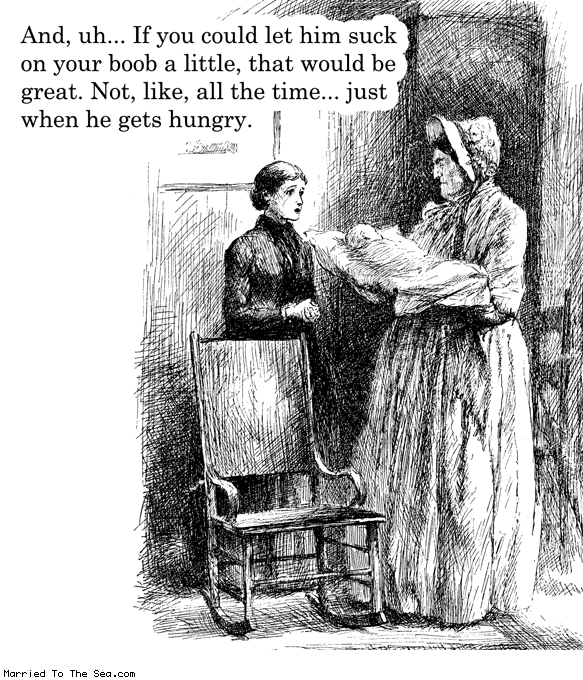
* And for the lighter side of things... I've just discovered the webcomic Married to the Sea, and in celebration they clearly did a comic just for me:


There are lots more!

Wednesday, July 20, 2011

The IUD comeback

When I was in college, I remember IUDs being completely dismissed as a form of contraception - they were barely even discussed, but I got the impression that they were some quasi-medieval little device that was only used by women who had already had at least 4 children.

Come grad school, IUDs were a hot topic in my MCH class, both academically and personally. For the personal side, at least a third of our cohort got IUDs, and academically they came up in almost every class discussion of family planning as an increasingly popular and very effective method of long-term contraception.

This Wired article does a nice job of summarizing the history behind the rise, fall, and rise again of the IUD.

By the early 1970s, 17 IUDs were under development by 15 different companies. The problems started with the fourth one to actually hit the market: the Dalkon Shield. AH Robins (which also made ChapStick and Robitussin) marketed one version of it as a smaller option for women who didn’t have children. Like all medical devices at the time, the Shield wasn’t vetted by the FDA. While drugs got careful screening, safety and efficacy claims on device labels did not. The FDA stepped in only if people started reporting problems. And report they did. ...

The new research [in the 90s] and thinking on IUDs had important implications for the future of the device. For one thing, it’s clear that doctors should not put it into women who have an active STD infection. (And even then, it’s only bacterial infections like chlamydia and gonorrhea that are problems; infection with the widespread human papillomavirus doesn’t disqualify anyone.) For another, inserting it under sterile conditions is paramount. To the people running these studies—and the doctors who read them in medical journals—the results were reassuring. There was nothing wrong with IUDs as a technology. ...

IUDs are on the verge of a remarkable return to popularity. Nationally, 5.5 percent of women using contraception choose them. That sounds unimpressive, but it’s the first time in more than 20 years that the number has risen above 2 percent; in 1995, it was 1.3 percent. By that baseline, 5.5 percent represents a sea change. And a few pharmaceutical companies believe that number is poised to grow.


There is plenty of reason to believe that more American women will be adopting the IUD when you compare our IUD use prevalence to that of other European countries, including Norway which tops out at 27% prevalence IUD use!

One interesting note is the price of getting an IUD in the U.S.

Also, the devices are expensive—the ParaGard costs $500, the Mirena $850. “It’s absolute highway robbery that these companies charge so much,” Espey says. “If you went to Home Depot and got the raw materials for a copper IUD, it would cost less than 5 cents.” And the hormones don’t contribute much more to the cost, she adds.

In fact, amortized over years of use—10 for the ParaGard and five for the Mirena—an IUD is far cheaper than birth control pills, which can cost $30 or more a month. But the initial outlay is difficult for some women to manage, and it’s not always covered by insurance. Schnuriger, who comes from a working-class St. Louis family, split the $450 cost of her IUD with her boyfriend. She used money earned from a work-study job to pay her half. If she keeps the ParaGard the full 10 years, it will end up having cost $3.75 a month.


Most people I know had insurance that did cover a pretty decent amount for the IUD and the appointment to get it inserted. But if you're paying out-of-pocket, it is a big investment even knowing that in the end it will probably be cheaper than other methods. Compare the prices we are paying in the U.S. with this: I have a friend working on an IUD project in West Africa. They offer only the Paragard (copper) IUDs. Price for the IUD + insertion? $3. Her expat friends get their IUDs before they come back to the U.S.

Saturday, February 19, 2011

Please stand with Planned Parenthood

I am sickened by the nakedly ideological attack by the Republican party on Planned Parenthood.

I cannot count the number of friends I know who have used Planned Parenthood as their ONLY affordable, accessible resource for gynecological care, birth control, STI testing, emergency contraception, and yes, also abortion. Those are services that save women's lives, and allow them to protect their current health and protect their future fertility. Regardless of what anyone may think of Planned Parenthood's provision of abortion services (a LEGAL service for which they use NO federal money, and to which all of 3% of their total funds go) the Republicans are attempting to defund a major source of Americans' access to primary health care. Not just reproductive health care - primary health care, period. For many people - especially women - Planned Parenthood is their primary care provider: they have nowhere else to go.

There is a conception by conservatives I have spoken to that Planned Parenthood pushes abortions and promiscuous sex (via "pushing" birth control?) and relies on somehow manipulating their consumers into these choices, all to make a profit (I guess the fact that they are a non-profit organization is just a minor detail.)

I knew someone exposed to this propaganda who was shocked - shocked - when she met a nurse who worked at Planned Parenthood and found out that this nurse was a normal, nice person who cared about mothers and babies. It was so completely different from the idea of Planned Parenthood that had been marketed to her by conservative religious organizations. It is an idea that is so ludicrous and at odds with my experiences and those of everyone I know who has used Planned Parenthood's services, or worked for their organization.

It's disgusting and disturbing, a ridiculous foundation for legislation, and I cannot imagine where millions of Americans will turn for these services if Planned Parenthood loses their federal funding.

Please stand with me in standing with Planned Parenthood and sign this petition now. Please share it with your friends on your blog, on Facebook, and/or via e-mail.

And please watch this video of a brave and honest woman sharing her personal experience, on the House floor:
Thursday, February 10, 2011

How much are spending cuts really cutting, and what would we lose?

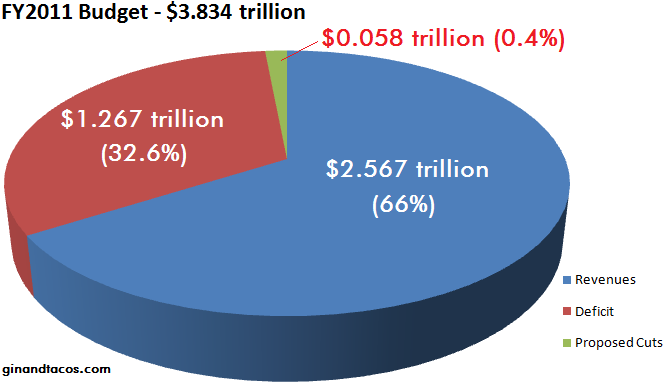
Sociological Images has a nice breakdown of Republicans' proposed spending cuts. Check out the post for a full discussion, but here is a helpful graphic:


So, in cutting 4/10s of 1 percent from the budget, what do we lose? Proposed cuts of over $1 billion to community health centers and the National Institutes of Health, among others. Oh, and let's not forget cutting the entire Title X family planning program. And $758 million from WIC.

I am so sick of the hypocrisy. This money spent on health and prevention prevents us from needing to spend much bigger sums elsewhere in the budget. Slash it, and watch other expenses rise. Or refuse to pay those expenses either, and let a huge swath of America suffer. Just to score political points ("we're not funding that horrible Planned Parenthood anymore!") for what amounts to a miniscule amount of total expenditures and doing very little towards deficit reduction.